

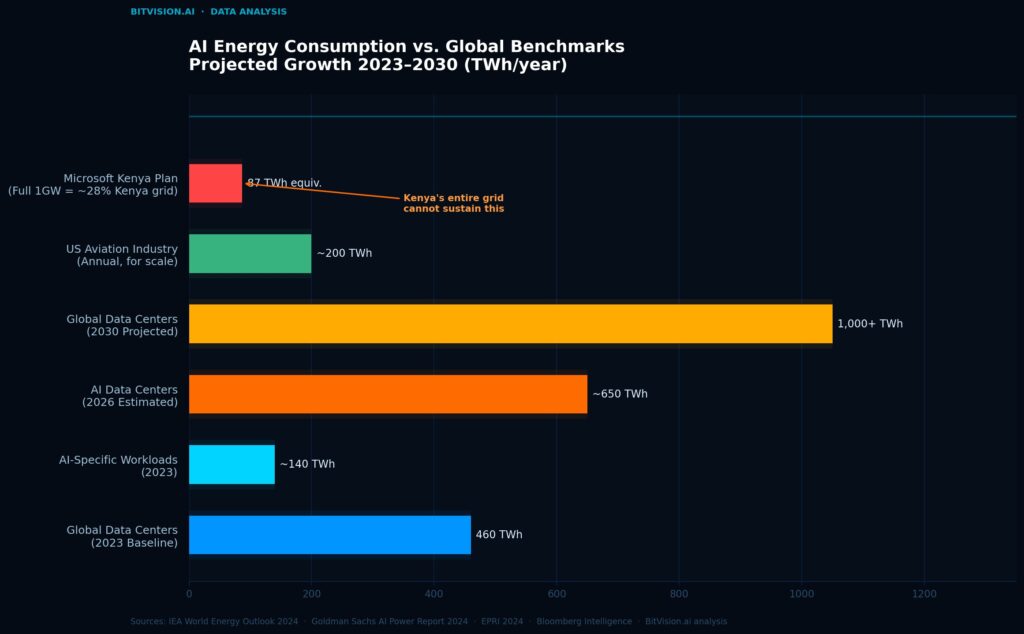
Two years ago, Microsoft made headlines with a bold promise: a massive AI data center in Kenya, powered by green energy, destined to scale to 1 gigawatt of computing — more than the combined capacity of most of Africa. President William Ruto called it a “revolutionary investment.” Brad Smith called it the “single biggest step” in Kenya’s digital history. The world called it the future.
Today, it’s stalled.
The reason? They forgot to check the power bill.
President Ruto himself recently admitted the uncomfortable truth at a Nairobi event: running the facility at full capacity would require “switching off half the country.” That’s not an infrastructure challenge. That’s a planning failure dressed up as geopolitics.
And here’s the uncomfortable part — Kenya isn’t the exception. It’s the preview.
The Chip Obsession Was Always a Distraction
For years, the AI conversation has been dominated by GPUs, silicon, and semiconductor supply chains. NVIDIA’s stock became a proxy for AI’s soul. Chip shortage? Crisis. New GPU launch? Celebration.
But semiconductors were never the ceiling. They were just the first bottleneck we hit.
The real constraint — the one now crashing into government AI strategies worldwide — is electricity.
Every AI query, every image generated, every autonomous agent running in the background, every enterprise LLM call consumes electricity inside data centers that run 24 hours a day, 365 days a year, at temperatures that would melt your laptop in minutes. Training a frontier model can consume more energy than a small town uses in a year. And that’s before inference at scale.
The AI boom is rapidly becoming one of the largest energy stories in modern history. Not metaphorically. Literally. Technology companies are now in direct competition — not just for chips, but for megawatts.
Nuclear power, small modular reactors, next-generation storage, and sovereign grid capacity are becoming strategic national assets. The country that controls reliable, abundant, clean power may have more AI leverage than the country with the best algorithms.
That’s the second problem nobody wants to say out loud at a government press conference.
But There’s a Third Problem. And It’s Worse.
Here’s what almost nobody is talking about: even if you solve the power problem, AI systems are still burning enormous computational energy on garbage.
Think about what AI actually processes at scale. The internet is not a library of verified, curated, high-quality information. It’s a landfill with a search bar. Duplicated content, fake websites, fraudulent identities, manipulated data, bot-generated noise — AI systems ingest all of it, repeatedly, at billions of operations per second.
Every time an AI model processes a fraudulent domain as if it were legitimate, or authenticates a fake wallet, or surfaces a spoofed brand as a trusted source — that’s not just a security failure. It’s an energy failure. Computational cycles were burned on data that should never have been in the pipeline in the first place.
This is the hidden inefficiency crisis at the heart of the AI energy crisis.
Verified Data Is an Energy Problem
This is where the conversation gets interesting — and where two companies are building infrastructure that matters far beyond their immediate market.
Verity One has been quietly building a certification layer for websites, products, and digital authenticity. Data Certify.ai focuses on domain verification, wallet ownership, brand reputation, and AI-ready identity systems anchored to the XRP Ledger.
These aren’t compliance tools. They’re efficiency tools.
When AI systems process verified, authenticated data rather than billions of unvalidated inputs, they waste less. Hallucination risks drop. Fraud detection becomes faster and cheaper. Cybersecurity workflows that currently require enormous computational overhead shrink dramatically when the data entering the pipeline is already certified as legitimate.
Some technology analysts now argue that in verification-heavy workflows — fraud prevention, compliance, digital identity validation, cybersecurity — moving to verified data infrastructure could reduce unnecessary AI computation by extraordinary margins. Not because the AI gets smarter. Because it stops doing stupid things with bad inputs.
Clean data isn’t just a quality issue. It’s an energy issue.
The New Hierarchy of AI Competitive Advantage
The Kenya story is a cautionary tale with a thesis buried inside it.
The next phase of the AI race won’t be won by whoever has the biggest model or the most GPUs. It will be won by whoever can solve the full stack:
Energy + Infrastructure + Verified Data + Trusted Identity.
Governments that announce AI visions before securing power grids will stall. Companies that scale AI workloads on unverified, low-quality data will burn money and energy for diminishing returns. And organizations that treat data authenticity as an afterthought will incur enormous computational costs for a problem that could have been solved upstream.
The future of AI belongs to the builders who understand that intelligence isn’t just about compute — it’s about what you compute, on what data, powered by what energy, authenticated by what trust layer.
Kenya’s stalled gigawatt is a reminder that ambition without infrastructure is just a press release.
The third problem — dirty data burning clean power — is the one the industry needs to start solving now.
BitVision.ai covers the intersection of AI, blockchain, digital infrastructure, and the forces reshaping the global technology order.