
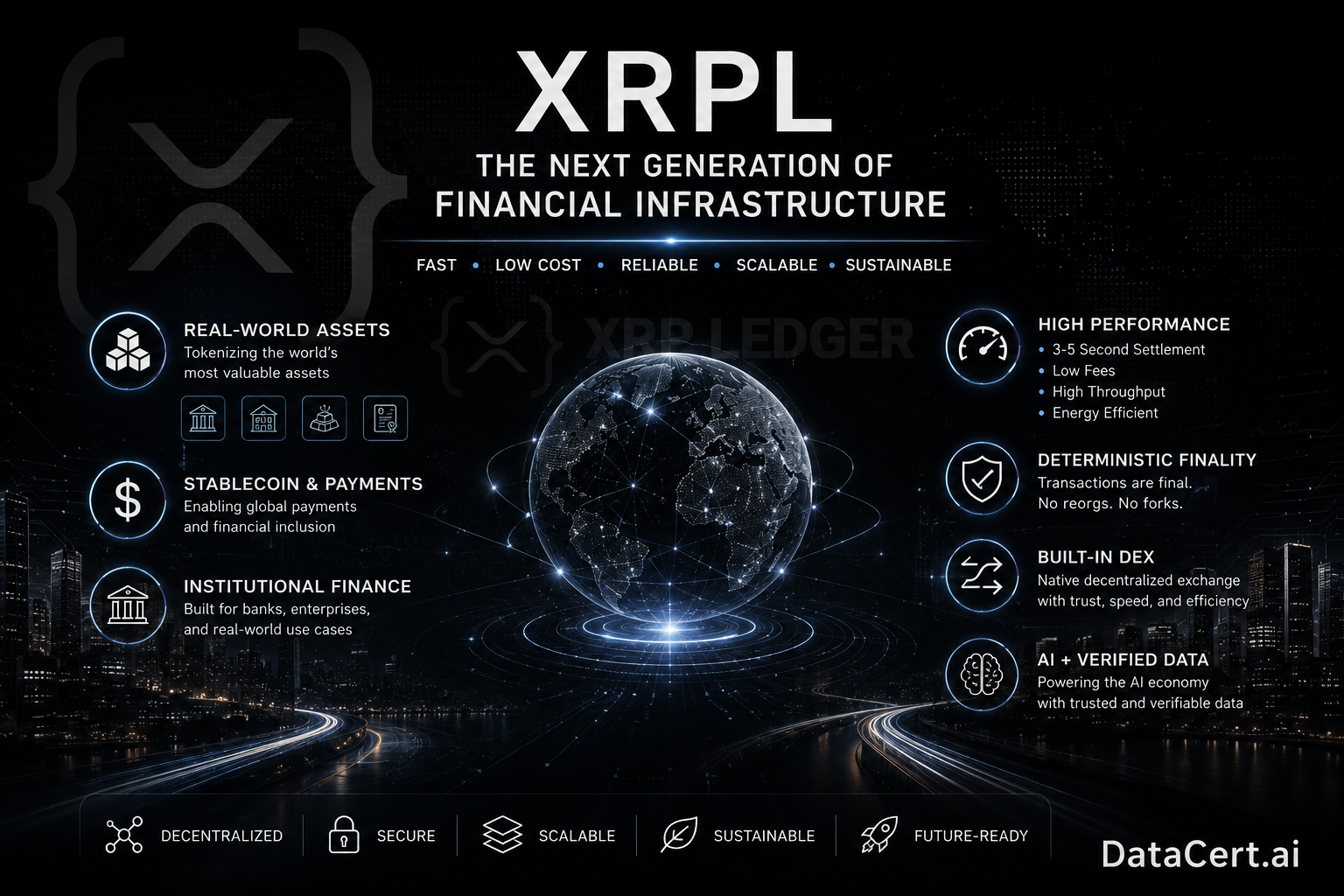
While the crypto crowd obsesses over meme coins and pump charts, something unusually boring — and therefore unusually important — is happening on the XRP Ledger. Real money. Real institutions. Real plumbing for the Internet of Value. Buckle up, because this is the infrastructure story of 2026.
Let’s be honest: most of crypto Twitter is not talking about 3-second settlement finality or deterministic ledger consensus. They’re talking about which dog-themed coin is mooning. And that’s precisely why XRPL keeps flying under the radar, quietly becoming the backbone that global finance didn’t know it needed.

Why XRPL Is Technically Different
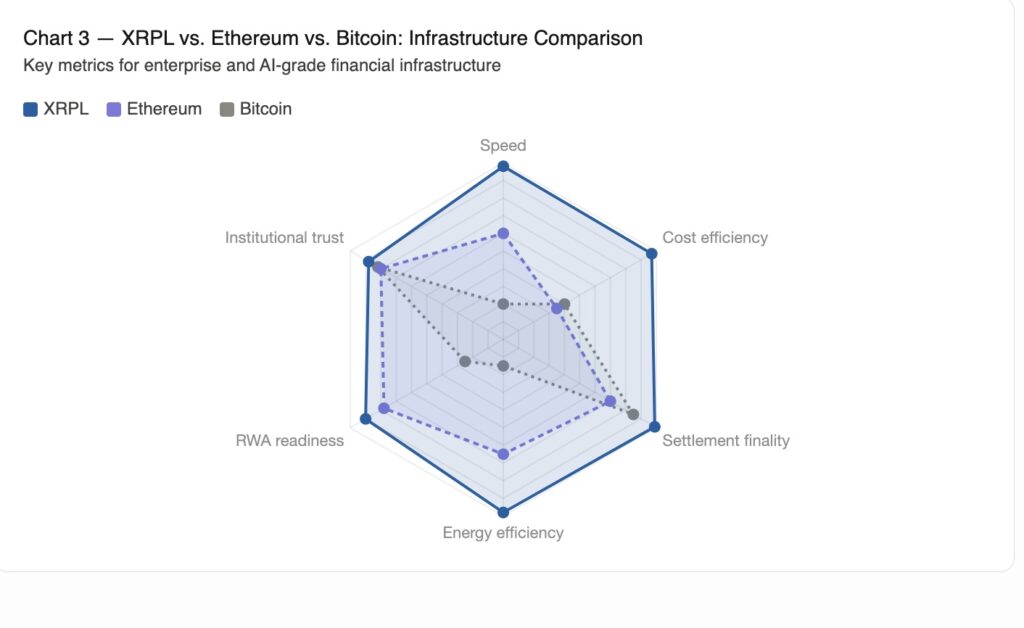
XRPL doesn’t mine. Full stop. While Bitcoin burns enough energy to power a small country and Ethereum still carries reorg risk, XRPL uses its Federated Byzantine Agreement (FBA) consensus protocol — validators agree every 3–5 seconds, transactions are final, and nobody’s wasting a GPU farm doing it.
Here’s what actually makes engineers excited (not the price, but the architecture): deterministic finality. Once a transaction closes on XRPL, it’s done. No rollbacks. No chain forks. No “wait for 6 confirmations.” For a bank moving $10 million cross-border, this is the difference between “we trust this” and “legal is going to need to sign off.” Traditional finance hates uncertainty more than it hates fees.
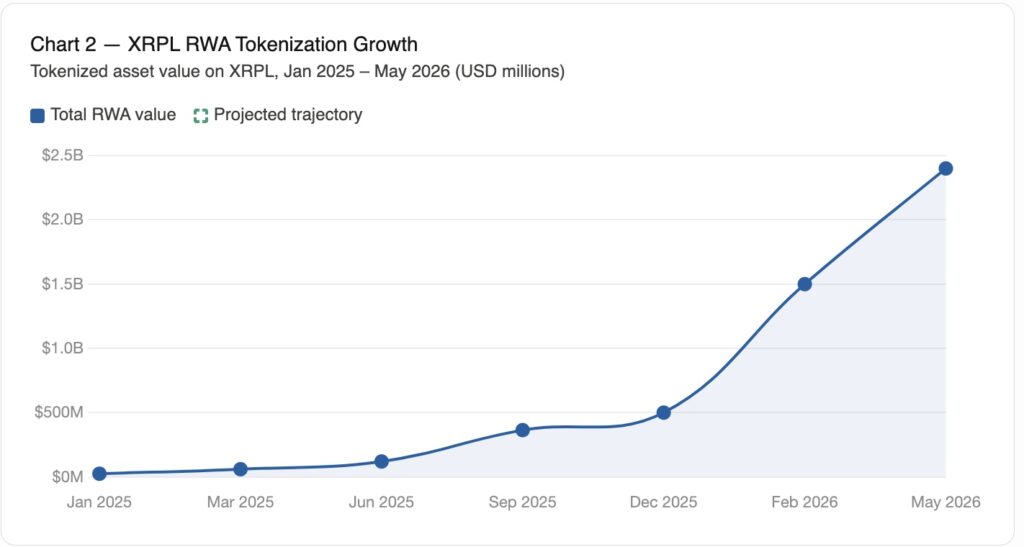
The RWA Explosion: From $24M to $2.4B in 16 Months
Here’s a number that should make you spit out your coffee: XRPL started 2025 with roughly $24.7 million in tokenized real-world assets. By May 2026, that figure had crossed $2.4 billion. That’s not a typo. That’s a 97x increase in under a year and a half — powered by Ondo Finance’s tokenized U.S. Treasuries, Archax’s institutional fund access, Guggenheim’s commercial paper, and Dubai’s government-backed tokenization projects.
XRPL now ranks second globally in 30-day RWA growth, trailing only Arbitrum, and has surpassed Solana, Polygon, and Avalanche in total tokenized value. Ripple’s Archax partnership alone is committed to bringing $1 billion on-chain by mid-2026. Ripple’s own RLUSD stablecoin hit $1.3 billion in market cap within its first year — the third-largest U.S.-regulated stablecoin. This is not speculation. This is capital moving.
The $16 Trillion Bet: Real-World Assets Go On-Chain
BCG projects that the global tokenized asset market will reach $16–19 trillion by 2030. We’re talking stocks, ETFs, real estate, Treasury bonds, gold, carbon credits, corporate debt and private equity. The assets are real. The question is: which ledger wins the settlement layer?
XRPL’s native DEX — built into Layer 1, not bolted on via smart contracts — gives it a structural edge. Trust Lines, Pathfinding, Auto-Bridging, a Central Limit Order Book (CLOB), and an Automated Market Maker (AMM) all operate natively. Security isn’t an afterthought. Execution is faster. Costs are lower. And there’s no $200 gas fee surprise waiting for your institutional client at checkout.
The AI Economy Needs Verified Data — XRPL Provides the Rails
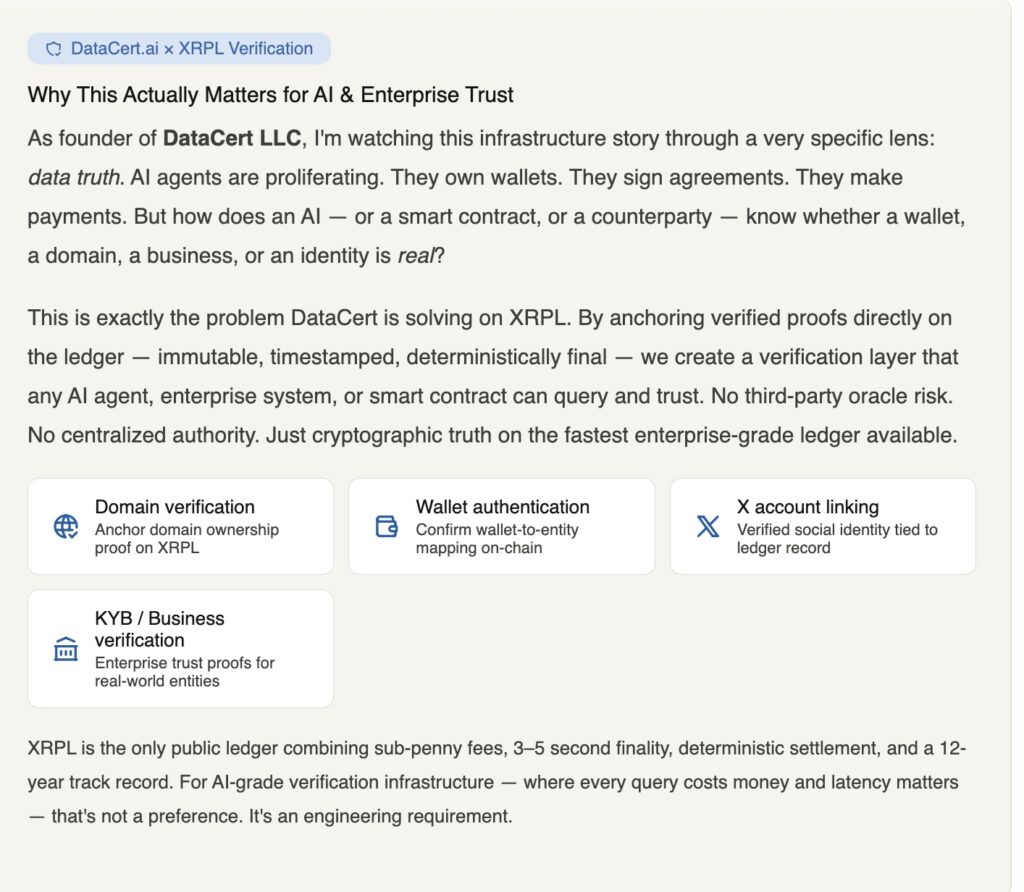
Here’s the macro thesis nobody’s writing about yet: the AI economy is going to generate an unprecedented demand for verified, trustworthy data. AI agents will pay for services, verify counterparties and sign micro-agreements at machine speed. High-gas chains like Ethereum are a non-starter for machine-to-machine micropayments at scale. XRPL — sub-cent fees, 1,500 TPS baseline, deterministic finality — is built for exactly this use case.
Ripple’s ODL (On-Demand Liquidity) already processed over $15 billion in cross-border payments in 2024, a 32% year-over-year increase. Daily active sender addresses hit 25,300 in Q3 2025 — a 142% quarter-over-quarter surge. The network is being used, not just admired from a distance.
The Biggest Misunderstanding: XRPL Is Infrastructure, Not a Bet
Most retail investors look at XRP and ask: “Will the price go up?” That’s the wrong question — or at least, an incomplete one. The better question is: “Will XRPL become the settlement layer for global tokenized assets, stablecoins, AI agent payments, and enterprise verification systems?” If yes, the token demand follows. Infrastructure wins aren’t announced. They compound.
Think about how underappreciated AWS was in 2008. Or how TCP/IP seemed like plumbing nobody cared about. The internet’s value didn’t live in domain names — it lived in everything built on top. XRPL is positioning for the same arc. The RWA numbers, the stablecoin adoption, the ODL volumes — these are the early signals of a network effect building quietly beneath the noise.

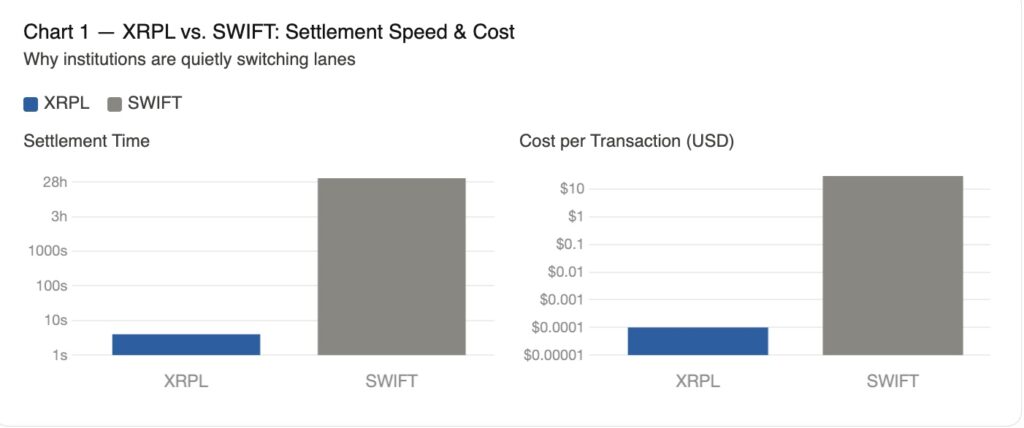
Bottom line: XRPL’s real competition isn’t Solana or Ethereum. It’s SWIFT. It’s correspondent banking. It’s the $400 trillion global financial system that moves money through fax machines and 3-day settlement windows. That’s a big target—and XRPL is the only public blockchain engineered from the ground up to compete with it. The boring infrastructure play is, as usual, the interesting one.