

Tech Week 2026’s real headline wasn’t another model. It was a question the whole industry is quietly tripping over: Can you prove what your machines just did?
New York Tech Week wrapped today — seven days, a thousand-plus events, and roughly the entire foundation-model establishment crammed into Manhattan and Brooklyn. a16z, OpenAI, Anthropic, Scale AI, NVIDIA, ElevenLabs. If you wanted to feel the future, the demos delivered. Agents booked travel, wrote code, moved value, and generally behaved like very confident interns who never sleep
But sit through enough of it, and you notice the demos were answering last year’s question. Can the model do the thing? It’s settled. Everyone assumes yes. The room full of people who actually ship — the ones nursing a seltzer in the corner instead of working the step-and-repeat — had moved on to a harder, less photogenic question:
Can you prove what it did, with what data, and defend that proof to a regulator, a counterparty, or a judge who has never heard the word “embedding”?
That question is where AI and crypto stop being a marketing collision and start being the same problem. And it’s the thread Bitvision readers have been pulling for a while.
The week’s real theme: from automation to auditable autonomy
Here’s the uncomfortable truth nobody could demo their way around. Autonomy and trust pull in opposite directions by default. Every time you take the human out of the loop, you also remove the moment where someone could have caught the mistake, the manipulation, or the quietly out-of-policy decision. Speed is the feature. The missing receipt is the bug.
Auditable autonomy is the fix: build the system so every consequential action can be independently verified after it happens. You stop trusting the action because you watched it. You start trusting it because you can reconstruct it. Three properties make that real:
- Integrity — proof that the claimed model, in the claimed configuration, on the claimed inputs, produced this output. Verifying a transaction on-chain is deterministic and cheap. Proving a model wasn’t quietly swapped for a cheaper one mid-flight is the genuinely hard part — and the frontier of the whole field.
- Provenance — a tamper-evident trail of where the data came from, how it was transformed, and who touched it. Without it, an answer can be perfectly correct and completely indefensible.
- Accountability — a real consequence when things go sideways. In crypto-native designs, that’s often economic: stake collateral, return a bad result, get slashed. No hand-wringing, no committee. Math.
Strip those away, and you don’t have autonomy. You have a very fast intern with no paper trail and no boss. Fun until something breaks.
Why AI and crypto are actually colliding (this time)
For most of the last cycle, “AI + crypto” was two buzzwords in a trench coat. In 2026, it finally has a narrow, defensible thesis: AI needs trustworthy data and verifiable execution, and blockchains are good at exactly those two things.
The architecture winning right now is hybrid, not religious. The blockchain doesn’t do the thinking — it anchors the things that must withstand scrutiny: input hashes, model hashes, governance decisions, the audit trail itself. The AI does what it’s good at, fast. Zero-knowledge machine learning (ZKML) and trusted execution environments are sliding from conference slides to baseline requirements for any protocol that guards real value. Agents are already running on non-custodial wallets with session keys and hard spending limits, keys tucked inside hardware-isolated enclaves.
Now the wise-uncle caveat, because Bitvision readers deserve the version that won’t embarrass you in six months: a large share of today’s “verifiable AI” still rests on trust rather than proof. Publishing a model hash and an inference proof is the right direction. It is not yet universal. The category is real, early, and oversold in the short term relative to what it’ll eventually justify. Which, conveniently, is exactly where the opportunity lives — between the promise and the proof.

What this means for digital assets
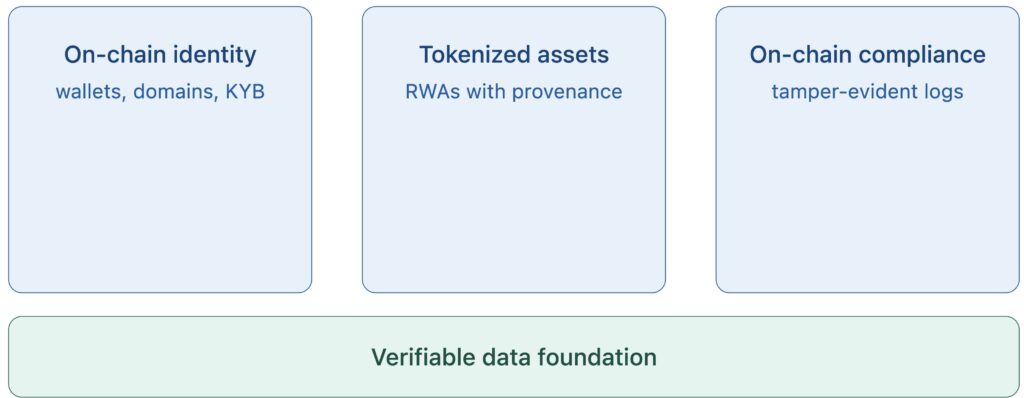
The crypto story is graduating from “what’s the coin worth today?” to “can this system be trusted tomorrow?” Three lanes are opening as a direct result, and all three rest on the same load-bearing slab:
- On-chain identity and verification — wallet, domain, and business identity you can check cryptographically instead of asserting in a PDF nobody reads. KYB and KYC become queryable records, not filing-cabinet theater.
- Tokenized assets with provenance — a real-world asset is only as good as the data trail behind it. Tokenization without provenance is just a prettier IOU with better branding.
- On-chain compliance and agent governance — purpose binding, kill switches, and tamper-evident logs that satisfy an auditor by construction, instead of by a frantic six-month archaeology dig.
Pull out the foundation under all three — verifiable data — and the pillars are decoration.
The regulators already moved the goalposts (while you were at the open bar)
This isn’t a thought experiment, and the floor rose under everyone in 2026. Under the EU AI Act’s high-risk regime, technical documentation now has to describe training-data provenance, and member states were required to stand up AI regulatory sandboxes by August 2026 — meaning you demonstrate compliant behavior under supervision, not merely swear you’ll behave. In the US, no new statute is even needed: HIPAA, GLBA, SEC, and FTC rules attach themselves to an AI system the instant it touches sensitive data.
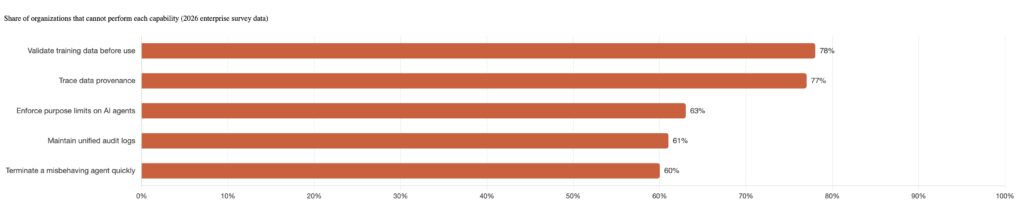
And the readiness gap is, frankly, spicy. Recent enterprise survey work found that roughly 77% of organizations can’t trace their data provenance, and about 78% can’t validate training data before using it. On the agent side, 63% can’t enforce purpose limits, and 60% can’t quickly shut down a misbehaving one — which is a polite way of saying most companies have handed their interns a corporate card and lost the off switch. A 2026 threat report drove it home: audit performance was the single strongest predictor of breach avoidance, regardless of company size.
Read that twice. The best-defended organizations aren’t the ones with the biggest security teams. They’re the ones who can show their work.
The real story is auditable data.
Strip away the agents, the tokens, and the branded tote bags, and Tech Week NYC 2026 made one argument on a loop: fast and opaque is no longer good enough. AI gives you speed. Blockchain gives you immutability. Neither one hands you truth on its own. Truth is the audit trail — the verifiable record of where data came from, how it was processed, who touched it, and how it shaped a decision.
Audited data is what lets you catch errors before they compound, surface bias before it ships, prove compliance before the regulator knocks, and earn a counterparty’s trust before the money moves. When an agent can move funds in milliseconds, your only durable moat is the ability to reconstruct, explain, and defend exactly what happened — at machine speed, on demand.
So here’s the line worth printing on next year’s tote bag: trust is no longer a vibe. It’s a receipt. The winners of this cycle won’t be the ones who automate the fastest. They’ll be the ones whose data can survive an audit — calmly, completely, and on the first ask.
Bitvision will keep pulling that thread. Bring receipts.