
How Global Brands Are Turning Tokens Into VIP Access Passes
Tokens Are No Longer Just Financial Instruments
For most of crypto’s history, tokens functioned as financial assets. You bought them, held them, and hoped for price appreciation. That simple model defined an entire era.
But that era is quietly ending.
Today, across industries—from coffee chains to luxury fashion houses—a new paradigm is emerging. Tokens are no longer just speculative vehicles. They are becoming access credentials: digital keys that unlock experiences, privileges, and status unavailable to the general public.
This shift is subtle, but structurally important.
Because the most meaningful upgrade to a token is not faster throughput or lower gas fees.
It is a real-world door that can only be opened with that token.
The Core Thesis: Tokens as Access Infrastructure
At its core, token-gated access reframes what a token represents.
Instead of pricing future expectations, the market begins pricing immediate, verifiable utility—who gets in, who stays out, and how scarce that access truly is.
This changes everything.
When access is:
- Scarce
- Time-bound
- Verifiable on-chain
…the token becomes more than an asset.
It becomes a proxy for participation in a limited system.
In that system, price is no longer driven purely by narrative.
It is driven by competition for access.
From Experiment to Execution: Brands Are Already Testing It
This is not theoretical. It is already happening—quietly, but at scale.
Starbucks: Loyalty Without Speculation
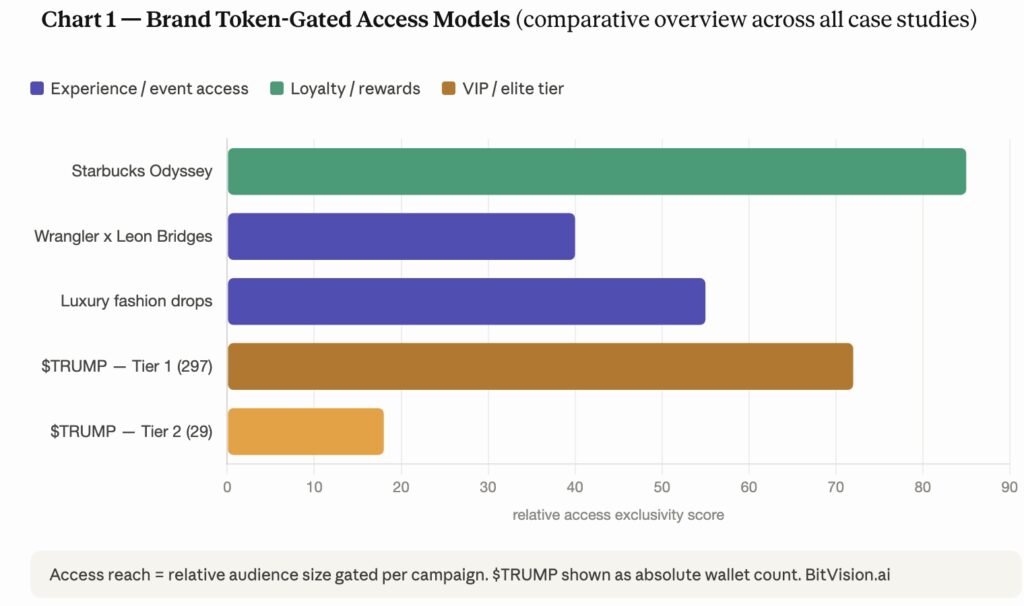
Starbucks’ Odyssey program introduced NFT-based “Journey Stamps” that unlocked experiences, including exclusive merchandise, classes, and private events.
Importantly, these tokens were earned, not bought.
Yet the underlying logic remained identical: hold the asset, unlock access.
Even though the program ended in 2024, it proved something critical:
Tokenized membership can work for mainstream users without speculative hype.
Music & Entertainment: Access Becomes the Product
When Wrangler partnered with Leon Bridges, NFT ownership didn’t just represent a ticket.
It was the ticket—plus backstage access and physical merchandise.
Here, the boundary between digital and physical collapsed.
The market wasn’t pricing an image.
It was pricing proximity.
And that distinction matters:
When access has real-world value, the token’s price gains a structural floor.
Luxury Fashion: Verifiable Exclusivity
Luxury brands have always sold scarcity. Tokenization simply makes it auditable.
Instead of private guest lists, access is now tied to wallets:
- No counterfeit invitations
- No hidden hierarchies
- No ambiguity
The blockchain becomes the source of truth.
In effect, brands gain something unprecedented:
a real-time, public map of their most valuable customers.
The Breakthrough Case: Leaderboards and Competitive Access
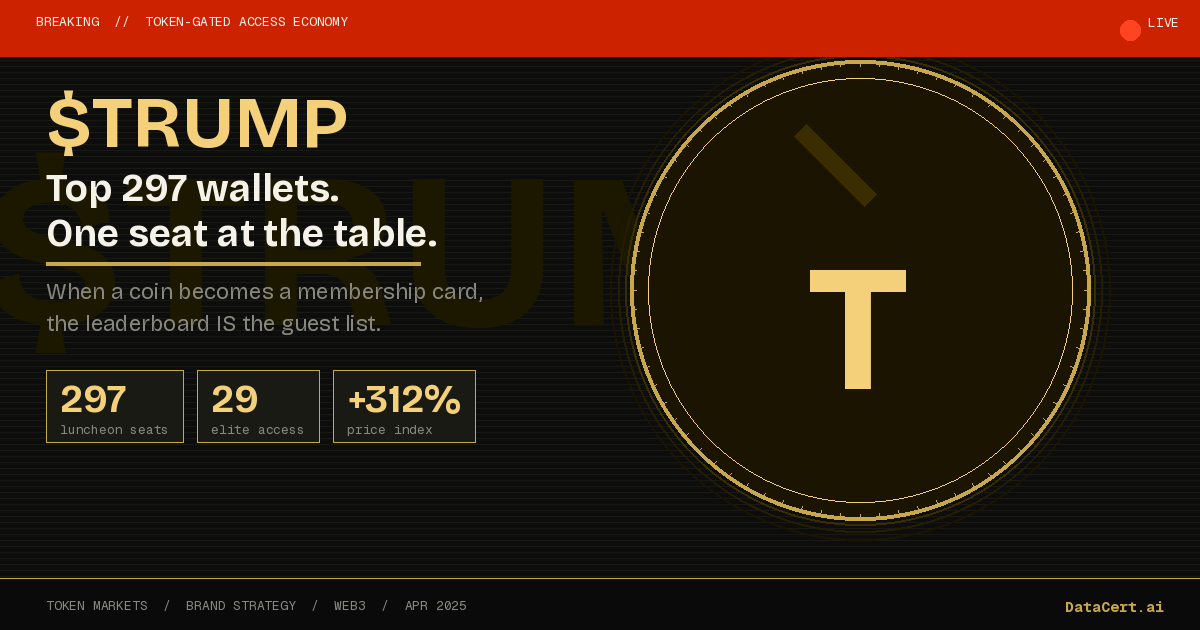
The most revealing example comes from a global personal brand that introduced a simple but powerful mechanic:
- Top 297 wallets received invitations to a private event.
- Top 29 wallets received enhanced access.
- Rankings were public, updated in real time
- A fixed event date created urgency
The result?
A fully transparent, competitive market for access.
For a brief period, the token price was not driven by sentiment—but by leaderboard dynamics.
Participants weren’t speculating. They were competing.
This is the key insight:
When access is finite and verifiable, demand becomes mechanical.
297 seats.
29 premium positions.
A public leaderboard.
That is not a meme.
That is a pricing engine for scarcity.
Why This Model Is So Powerful
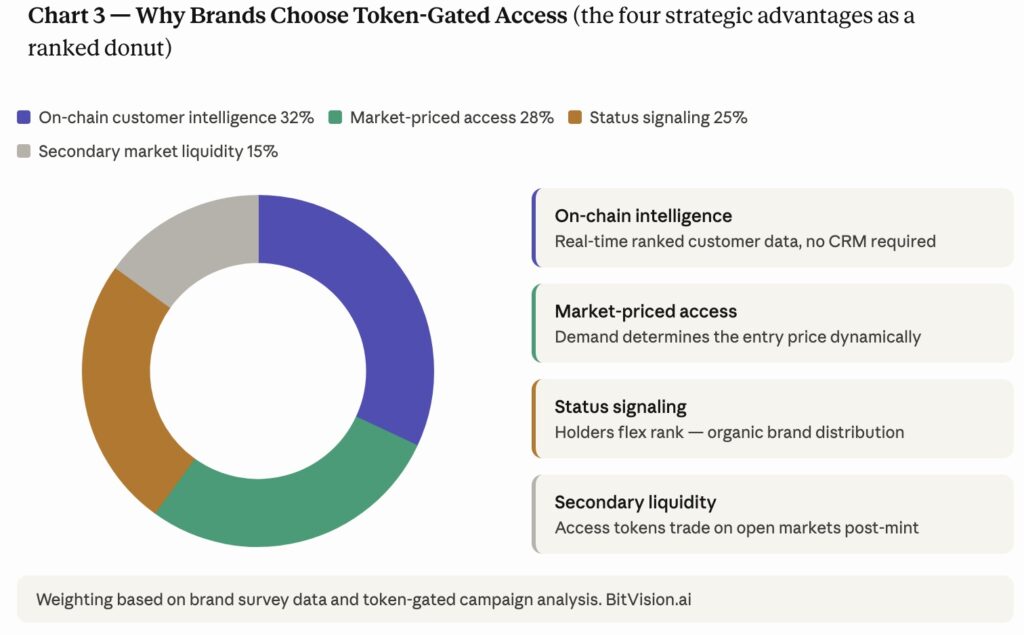
Token-gated access works because it solves three problems simultaneously.
1. Real-Time Customer Intelligence
Wallets replace CRM systems.
Brands can instantly identify:
- Top holders
- Most engaged users
- Behavioral patterns
All without surveys, tracking pixels, or third-party data.
2. Market-Priced Access
Traditional ticketing sets fixed prices.
Token-gating allows the market to decide the price of entry in real time.
As demand increases, token value rises.
If the brand holds supply, it captures that upside directly.
3. Built-In Status Signaling
Ownership becomes visible.
Holders display:
- Wallet rankings
- NFT collections
- Access privileges
This creates organic marketing.
Every holder becomes a distribution channel.
What This Means for Markets
For Traders: Predictable Event Cycles
Token-gated events introduce repeatable patterns:
- Pre-event accumulation
- Leaderboard competition
- Post-event distribution
- Narrative-driven attention cycles
These are not speculative anomalies.
They are structural behaviors tied to access scarcity.
For Builders: Utility Must Be Real
The models that succeed share one principle:
The access must be meaningful.
If the experience is:
- Real
- Deliverable
- Desirable
…the token holds value beyond price speculation.
If not, the system collapses.
The BitVision.ai Perspective
At BitVision.ai, the thesis is simple:
On-chain behavior is the most underutilized signal in crypto.
Token-gated systems make that signal even clearer.
You can see:
- Wallet accumulation in real time
- Leaderboard shifts
- Whale positioning
- Pre-event flows
This is not noise.
It is structured demand data.
And those who read it early gain a measurable edge.
The Bigger Shift
This is not just a new use case.
It is a structural evolution.
Crypto is moving:
- From speculation → participation
- From price → access
- From narrative → verifiable utility
The next cycle will not be defined by which token goes up the most.
It will be defined by which tokens unlock something real.
Conclusion
The transition from memecoin to membership is not a trend.
It is a redefinition of value.
Across industries, one pattern is emerging:
- A token
- A threshold or leaderboard
- A door
For traders, that door is a signal.
For brands, it is a monetization engine.
For builders, it is a design challenge.
And for the market as a whole, it is proof of something deeper:
Utility is no longer optional.
It is becoming the price.