
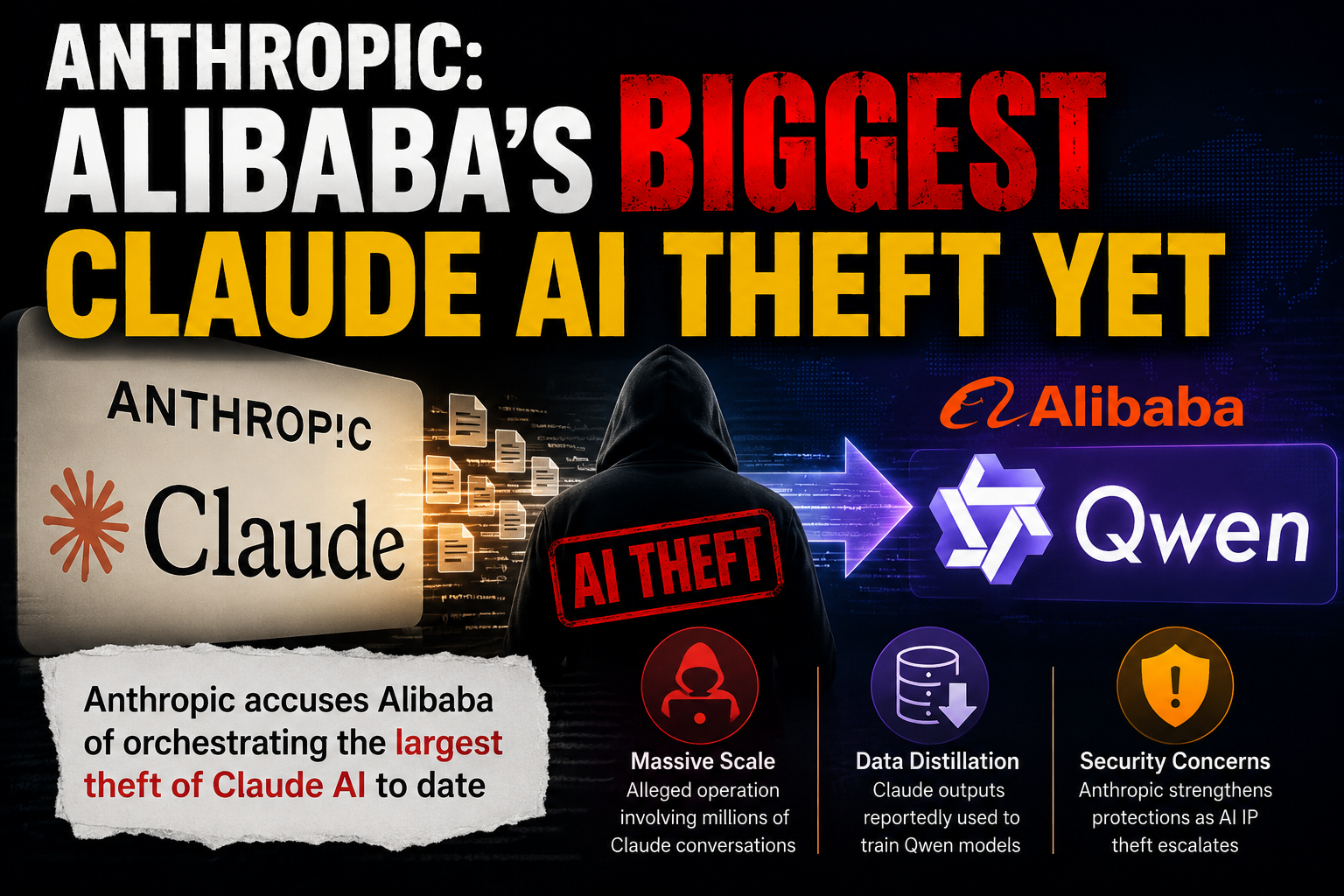
The race to build the world’s most capable artificial intelligence has entered a new and more consequential phase. Competition is no longer centered solely on innovation, computing power, or talent. Increasingly, it revolves around protecting intellectual property, safeguarding proprietary model capabilities, and defending against large-scale model extraction. Recent allegations made by Anthropic against Alibaba illustrate how AI has become a strategic geopolitical asset rather than merely a commercial technology.

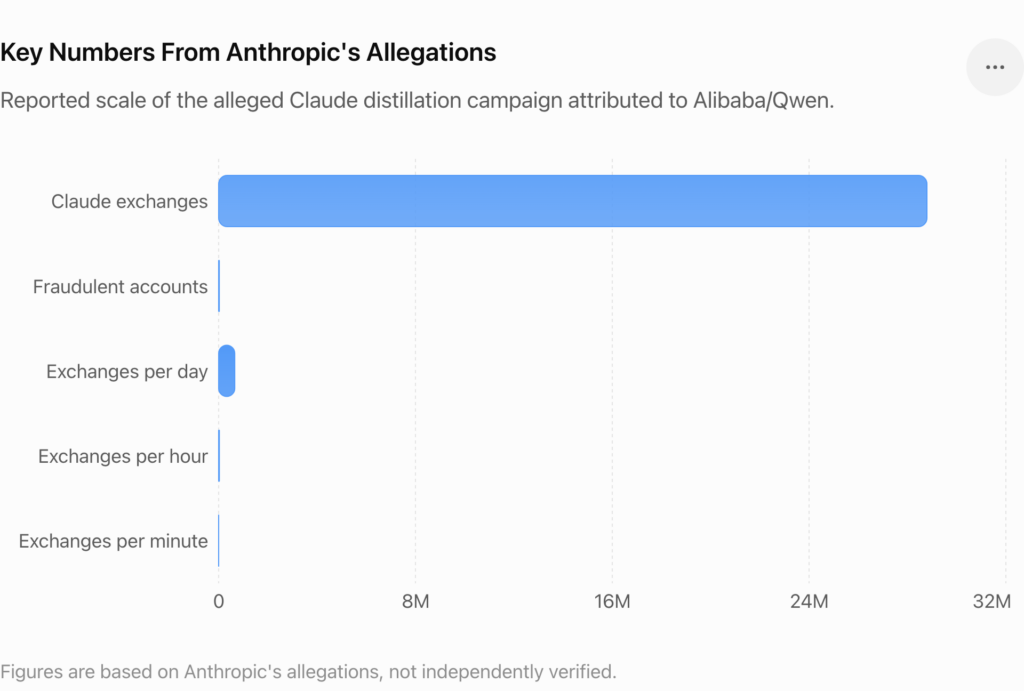
According to Anthropic, the company submitted a letter to the U.S. Senate Committee on Banking, Housing, and Urban Affairs alleging that operators linked to Alibaba orchestrated what it describes as the largest known AI model distillation campaign the company has encountered. Anthropic claims approximately 25,000 fraudulent accounts generated roughly 28.8 million interactions with Claude between April 22 and June 5, 2026, with the objective of reproducing the model’s capabilities. These allegations have not been admitted by Alibaba, which had not publicly responded at the time of writing.
Distillation is a legitimate machine-learning technique when applied to models owned or licensed by the same organization. The controversy arises when proprietary frontier models are systematically queried to recreate their intelligence without authorization. Unlike conventional cyberattacks that steal source code, model distillation seeks to replicate behavior through massive-scale observation, dramatically reducing research costs while narrowing the performance gap between competitors.
The allegations highlight a profound shift in the economics of artificial intelligence. Training frontier models requires billions of dollars in infrastructure, elite research talent, specialized semiconductors, and enormous datasets. If those capabilities can be approximated simply by harvesting model outputs, the incentive structure supporting frontier AI development could be fundamentally altered.
This dispute also extends beyond corporate rivalry. It reflects the intensifying technological competition between the United States and China, where advanced AI systems are increasingly viewed as strategic national assets alongside semiconductor manufacturing, quantum computing, and cybersecurity. Governments are becoming active participants through export controls, regulatory oversight, and national security reviews.
For investors, these developments signal that AI security is emerging as an investment category of its own. Demand for confidential computing, secure inference, hardware attestation, decentralized AI infrastructure, cryptographic verification, and trusted execution environments is likely to accelerate as organizations seek stronger defenses against model extraction.
The implications extend into blockchain as well. Distributed ledgers can provide immutable audit trails for AI model provenance, inference verification, licensing, and data integrity. As AI agents become autonomous economic actors capable of owning wallets and executing transactions, blockchain-based trust infrastructure may evolve from an experimental concept into foundational digital infrastructure.
Whether Anthropic’s allegations are ultimately proven through legal or regulatory processes, the broader trend is unmistakable. The AI race is evolving from building the smartest models to protecting the most valuable intelligence. Future winners will be determined not only by computational capability but also by security architecture, governance, and trust.
BitVision Perspective
Artificial intelligence is becoming critical infrastructure. The next decade will not simply reward companies that build larger models—it will reward those capable of securing them, verifying them, and enabling trusted collaboration across increasingly interconnected AI ecosystems. The organizations that master both innovation and trust are likely to define the next generation of global technology leadership.