
The search for the “next NVIDIA” has become a hot topic in the semiconductor industry. NVIDIA’s success and its $2 trillion valuation have sparked interest in identifying companies that can replicate or surpass its achievements.
During the 1990s tech boom, Google, Facebook, smartphones, and wireless apps were yet to be invented. However, Cisco was the backbone of the internet, providing all the routers that connected homes and businesses to the “world wide web,” with Intel supplying the necessary chips. Cisco was a leading company, even becoming the world’s largest for a while, with a $200 billion market cap.
Now, Cisco remains a successful company, but its market cap is only a fraction of tech giants like Apple, Amazon, and Nvidia, which have market caps between one and three TRILLION dollars. This raises the question: has Cisco lost its touch? No, Cisco is still a dominant player in its field, producing routers that connect people to the internet. However, the issue lies in the fact that most people are already online.
New companies will always require routers, and old ones will eventually become obsolete, requiring replacements. The initial excitement of hardware innovation can generate significant profits for the leading company. However, capitalism eventually kicks in, leading to increased competition from those trying to dethrone the leader or carve out a space for themselves as a viable alternative to a monopoly.
And then, as the hardware becomes a commodity, the prices go down, margins slim, and then suddenly people don’t need that commodity anymore. Competition Heats Up in AI Nvidia (NVDA) has an 86% market share.AI chips make up a 10% market share of the $500 billion+ chip industry. By 2027, chips might be 50% of the market. And Nvidia has the best chip out there. The best! But here’s the thing: Maybe NVDA no longer has the best chip. Maybe Advanced Micro Devices, Inc. (AMD) with their MI300s is now the fastest chip.
5-Year Chart of Advanced Micro Devices (AMD)
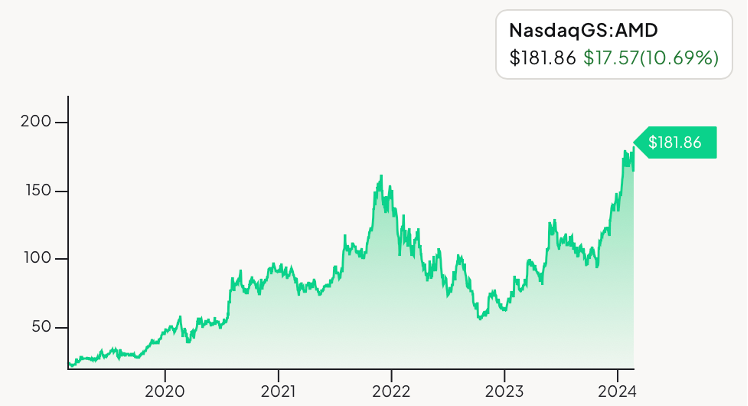
While AMD’s share price has gone to the moon, the company is still a fraction of the size of NVIDIA.
AMD’s valuation is around $290 billion trading at an EV/Sales of 12 compared to NVIDIA at $1.9 trillion with an EV/Sales of 38. This gives us a feel for how much institutional capital has been dumping into NVIDIA purely on momentum.
Notable players like OpenAI’s CEO Sam Altman and Softbank are also entering the race. OpenAI aims to raise $7 trillion to establish a competitor to NVIDIA and enhance the resilience of semiconductor supply chains. Softbank, on the other hand, has invested in ARM Holdings and plans to raise $100 billion to create its own rival to NVIDIA.
The reality is that there is an incredible amount of capital looking to invest in companies that can compete with NVIDIA. And a handful of them will be successful or get acquired by a larger semiconductor company along the way.
Either way, we’ll plan on being there for the ride…