
By Michelle Tan
A Story: When Proof Becomes More Valuable Than Product
A customs officer scans a shipment arriving at a U.S. port. The goods are labeled “Made in USA.” The supplier provides certificates, documents, and compliance reports. Everything looks legitimate — yet counterfeit origin fraud has become a billion-dollar industry. Paperwork can be edited. Databases can be manipulated. Even digital certificates can be forged.
In a world where artificial intelligence can fabricate documents, images, identities, and voices in seconds, trust cannot rely on claims alone. It must rely on cryptographic proof.
This moment marks a turning point in global commerce: proof has become more valuable than the product itself.
And yet, the digital economy still lacks a universal system to prove the origin, authenticity, compliance, and integrity of real-world data. That missing system is now emerging — the Data Wallet.
The Problem: An Economy Running on Unverified Claims
Modern markets run on assertions:
“This product is authentic.”
“This company meets ESG standards.”
“This carbon credit represents real impact.”
“This dataset is legitimate.”
But most verification systems remain fragmented — spreadsheets, PDFs, siloed databases, third-party auditors, and manual compliance processes. These systems were never designed for an AI-driven, real-time, globally tokenized economy.
As Real World Asset (RWA) tokenization accelerates — from commodities and supply chains to environmental credits and intellectual property — the lack of verified source data becomes a systemic risk. A tokenized asset without verifiable underlying data is simply digitized uncertainty.
Web3 solved value transfer.
It has not yet solved the problem of truth transfer.
The Solution: The Data Wallet
Instead of storing unverifiable claims in scattered databases, each product, company, shipment, certificate, dataset, or environmental asset receives a unique cryptographic identity — a wallet that holds its verified data history.
In simple terms:
If a crypto wallet holds financial assets, a Data Wallet holds verified reality.
This transforms verification from a manual process into an automated, programmable, tamper-proof trust infrastructure.
The Technology: How a Data Wallet Works
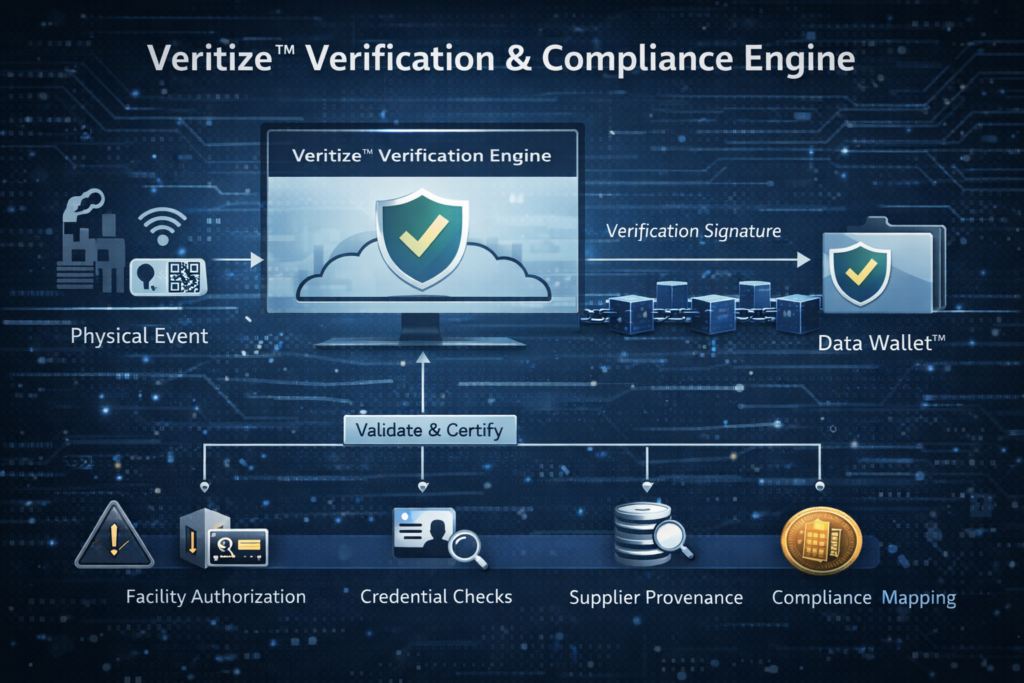
Each Data Wallet is created with a public-key identity and a cryptographic hash fingerprint. This fingerprint acts as an immutable anchor — once recorded, any alteration becomes instantly detectable. Every event in the lifecycle of a product or entity — manufacturing, inspection, transport, certification, lab testing, regulatory approval — is recorded as a signed data transaction inside the wallet.
IoT sensors, RFID tags, QR codes, laboratory systems, enterprise software, and AI monitoring tools feed real-world data into the wallet. Each data input is time-stamped, signed, and anchored to blockchain networks, ensuring that historical records cannot be rewritten. Multi-chain compatibility allows Data Wallets to interact seamlessly across public and private blockchains, enterprise systems, and regulatory databases.
Permissioned access layers allow selective disclosure — regulators see compliance data, buyers verify authenticity, banks validate collateral, and consumers scan provenance — all without exposing proprietary information. This creates a balance between transparency, privacy, and security, enabling large-scale enterprise adoption without compromising confidentiality.
The result is a self-verifying digital passport for anything that needs trust.
From Compliance Cost to Economic Infrastructure
Today, global industries spend over $2 trillion annually on compliance, auditing, certification, anti-counterfeiting, and supply chain verification. These are slow, manual, and reactive systems.
Data Wallets transform verification into:
- Instant
- Automated
- Machine-readable
- Globally auditable
- Fraud-resistant
A regulator can verify origin in seconds.
A buyer can confirm authenticity before purchase.
A lender can verify collateral before financing.
A stablecoin system can verify counterparties before settlement.
Compliance becomes real-time infrastructure, not paperwork.
The Market: A Trillion-Dollar Opportunity
The demand for verified data spans multiple massive markets:
Supply Chain & Manufacturing
Global supply chain traceability market: $25B by 2030
Anti-Counterfeiting & Brand Protection
Losses exceed $500B annually.
Food & Agriculture Traceability
Market projected $30B+ by 2032
Carbon & Environmental Credits
Expected to surpass $1T by 2030
Pharmaceutical Track & Trace
Projected $15B+ market
AI Training Data Verification
Emerging multi-billion-dollar sector
Tokenized Real World Assets (RWA)
Projected $10T+ market by 2030
Every one of these sectors shares the same requirement: provable authenticity of underlying data.
Without verified data, tokenized markets cannot scale.
With Data Wallets, verified data becomes a tradable digital asset class.
Why Now: The Convergence Moment
Seven forces have aligned:
- AI has made misinformation scalable.
- Governments are enforcing traceability laws.
- Stablecoins are becoming a regulated financial infrastructure.
- RWA tokenization is accelerating.
- Supply chains are reshoring.
- Consumers demand transparency.
- Blockchain infrastructure has matured.
All technologies are ready.
All markets are demanding.
Only the trust layer was missing — until now.
The Next Economy: Verified Commerce
Once Data Wallets become standard:
- Products carry self-verifying identities.
- Payments execute only against verified goods.
- Financing is issued against verified collateral.
- Environmental credits settle instantly with proof.
- AI models train on verified datasets.
- Global trade becomes fraud-resistant
This is verified commerce — where trust is programmable.
Closing Thought
The internet gave us information.
Blockchain gave us digital value.
Data Wallets give us digital truth.
In an era where anything can be fabricated, the ability to prove reality becomes the most valuable infrastructure of all.
The Data Wallet is not an application.
It is not a feature.
It is the trust infrastructure of Web3 — and the foundation of the next digital economy.