
History is often written through presidents and generals. But more often, history is decided by engineers — and by the nations willing to fund them.
In the 1930s, a quiet French mechanical engineer named Eugene Houdry discovered how to transform low-quality fuel into high-octane gasoline. His invention — catalytic cracking — would become the invisible force behind Allied air superiority in World War II.
But Houdry’s brilliance alone was not enough.
France, suffering economic depression and lacking oil resources, refused to invest in scaling up its invention. His government withdrew funding. His breakthrough risked dying in a laboratory notebook.
Then, across the Atlantic, one American company recognized the strategic importance of his work.
Vacuum Oil Company — later part of Standard Oil and eventually Mobil — invited Houdry to the United States, provided capital, facilities, and industrial backing, and told him simply:
Build it.
By 1937, the first Houdry catalytic cracking plant was operating in America. Three years later, British and American aircraft were flying on 100-octane fuel while German refineries could only produce 87-octane gasoline. The Battle of Britain was decided not by aircraft design, but by fuel chemistry and industrial investment.
The lesson was clear:
Energy dominance creates industrial dominance.
Industrial dominance creates intelligence dominance.
Intelligence dominance creates geopolitical dominance.
That formula built the American century. And it will decide the next one.
The New Strategic Bottleneck
Today, the world is entering the age of artificial intelligence. Data centers already consume more electricity than many nations. Next-generation AI clusters require gigawatts of continuous power — enough to power entire cities just to keep computation running.
In this new era, electricity is no longer just a utility.
It is the limiting factor of national competitiveness.
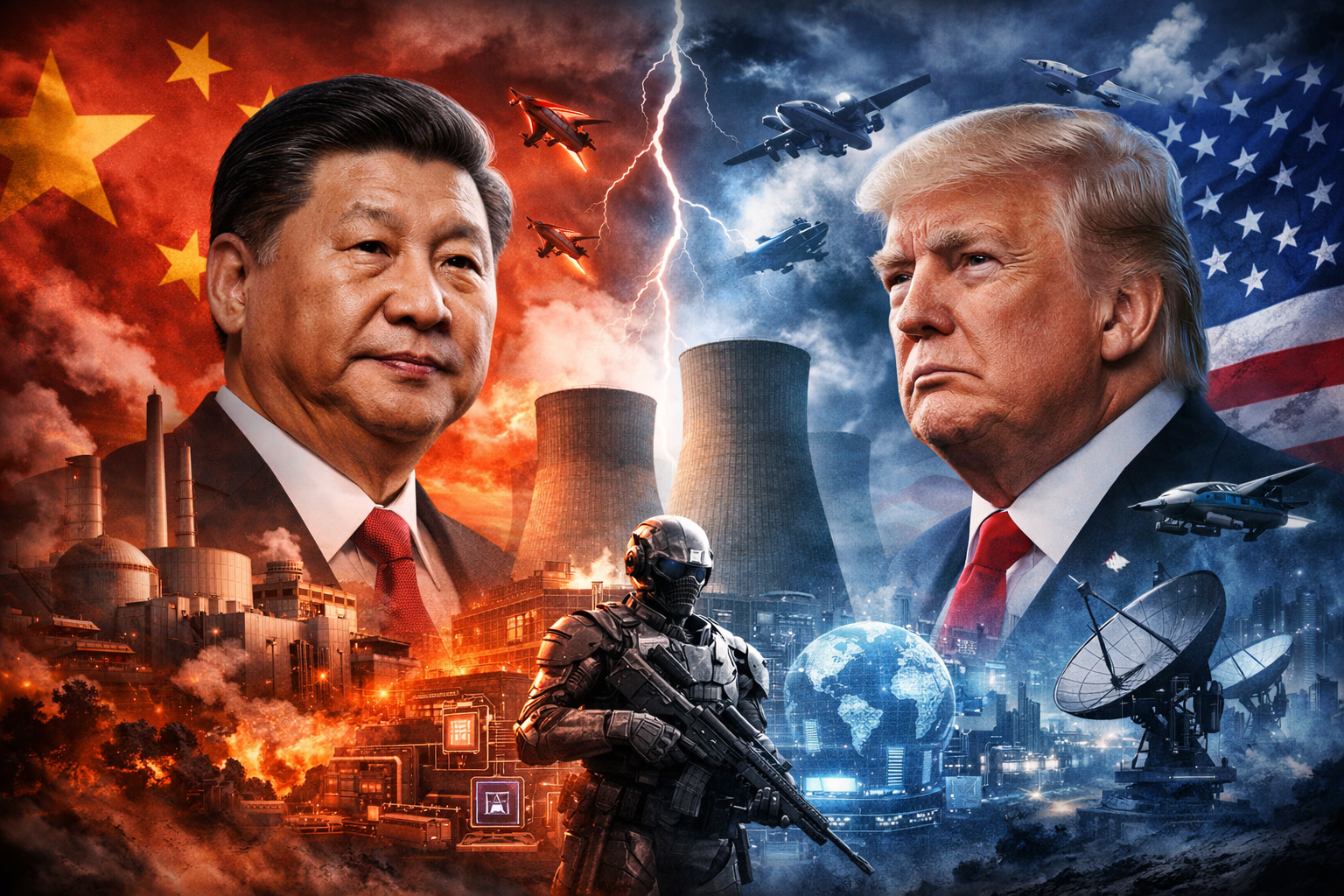
China now generates more than twice the electricity of the United States and is expanding nuclear capacity at a historic speed. Whoever controls abundant, reliable baseload power will control the pace of AI development, advanced manufacturing, and defense automation.
This is not speculation.
It is physics.
No software breakthrough can overcome an electricity shortage.
Why Nuclear Is Inevitable
Fossil fuels face emissions constraints.
Wind and solar face intermittency.
Battery storage faces scale limitations.
Meanwhile, AI demands uninterrupted power at a massive scale.
There is only one proven solution:
Nuclear energy.
But nuclear technology has evolved. The new generation of Small Modular Reactors (SMRs) is factory-built, faster to deploy, passively safe, and scalable by design. They can be placed directly beside industrial parks, military installations, and data-center campuses.
Governments and private capital are already moving:
• TerraPower Natrium project in Wyoming
• Oklo’s advanced micro-reactors
• NuScale’s SMR rollout
• Westinghouse’s global reactor expansion
The nuclear renaissance has begun.
The Uranium Supply Constraint
Every reactor needs fuel.
Every fuel cycle begins with uranium.
For decades, uranium investment lagged. Mine’s closed. Inventories shrank. Supply chains are concentrated in unstable regions. Now, as nuclear demand accelerates, a structural uranium shortage is forming.
In strategic industries, scarcity creates leverage.
The Company at the Center
One company stands at the center of this transformation.
Once known simply as the world’s largest private uranium producer, it has now become a vertically integrated nuclear infrastructure powerhouse.
It controls uranium mining.
It supplies nuclear fuel.
It owns 49% of Westinghouse, one of the world’s leading reactor manufacturers.
No other company on Earth commands the nuclear value chain end to end.
That company is:
Cameco (CCJ).
The Strategic Conclusion
In the 1940s, catalytic cracking unlocked air superiority.
In the 2030s, nuclear power will unlock AI superiority.
The nations that fund infrastructure breakthroughs will lead.
The companies that control nuclear fuel will become strategic assets.
France lost Houdry.
America funded him — and won an era.
The same choice now stands before us again.
Those who control energy will control the future.