
Why Energy and Verified Truth Are the Real Constraints on AI’s Future
Artificial intelligence is accelerating at a pace that is reshaping industries, markets, and global power structures. Trillion-dollar valuations, chip wars, and a race among sovereign nations have made AI the defining technology of our era.
Beneath the headlines, two structural constraints now shape the winners and losers in the AI economy.
The first is electricity. The second is truth.
Neither is solved, but both present investment opportunities.
⚡The Power Constraint Nobody Is Talking About
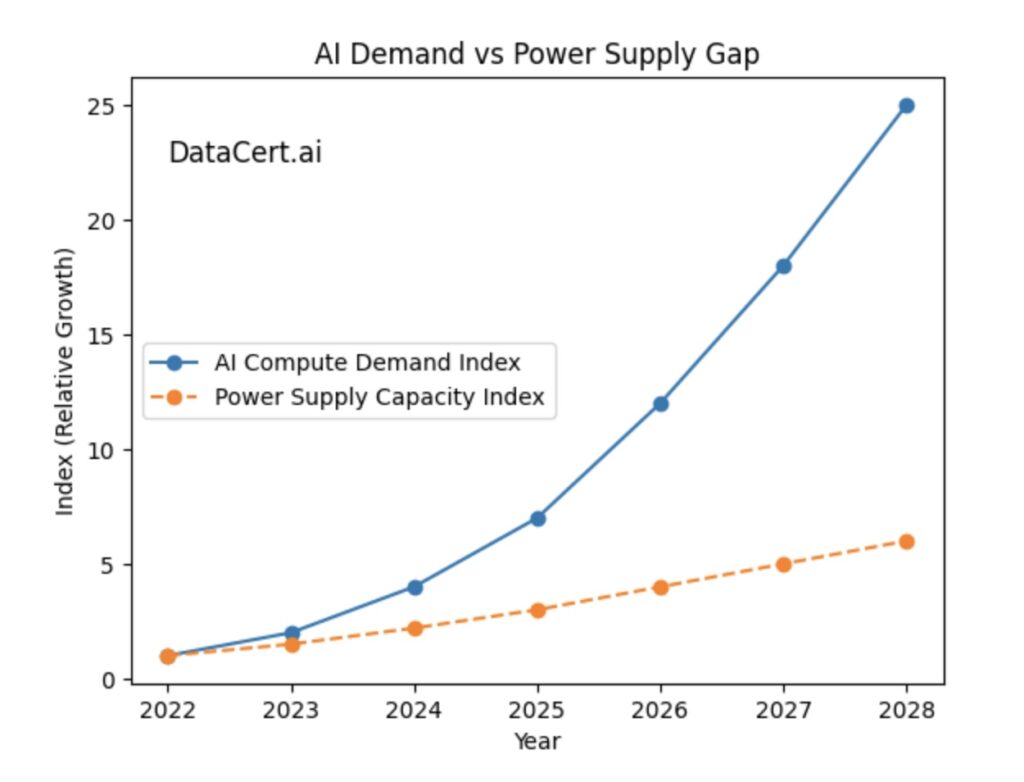
Many advanced US data centers are built and equipped, but sit idle.
They lack electricity, not chips or finished software.
Grid interconnection queues in many U.S. regions now stretch beyond five years. For a mid-sized facility awaiting commissioning, that delay translates into hundreds of millions of dollars in lost annual revenue. For hyperscale operators with billions deployed, the stakes are existential.
The hardware bottleneck is solved. Now, connection to the grid is the challenge.
This is a growing structural constraint, not a temporary one, as AI workloads and energy demand outpace supply.
🔌The Infrastructure Layer Most Investors Are Overlooking
When analysts discuss the AI investment landscape, they tend to focus on the obvious: model developers, cloud providers, and semiconductor companies. These are the visible layers of the stack.
But the real leverage sits one level deeper — in the electrical infrastructure that must be in place before a single inference can run.
Before any AI model processes its first query, the facility running it needs:
- High-voltage power conversion
- Precise distribution and load balancing
- Fault protection and stabilization systems
- Custom switchgear engineered for extreme power density.
Demand has surged. Equipment lead times stretch for years. Customization is now standard as designs push engineering limits.
Time-to-deployment drives AI advantage. Control over power delivery sets the pace for scaling.
🧠The AGI Inflection Changes the Calculus
A threshold is near; constraints are fundamentally changing.
Leading technologists and AI researchers have begun describing artificial general intelligence not as a distant horizon but as a near-term milestone. Whether you define AGI technically — as a system capable of performing any cognitive task a human can — or economically, as a system capable of autonomous, self-directed research and optimization — the implications for infrastructure are the same.
At that inflection point:
- AI systems will operate continuously, not in episodic bursts.
- They will conduct research and generate economic output autonomously.
- Innovation throughput will be limited not by human bandwidth but by compute and energy supply.
Put plainly, electricity becomes the new oil. The companies and nations that control reliable, high-capacity power delivery will control the pace of AI advancement — and the pace of value creation.
🌐The Second Bottleneck: Verified Truth in an AI-Saturated World
The energy problem is well-defined and increasingly understood by infrastructure investors. The second constraint is subtler — and in the long run, arguably more consequential.
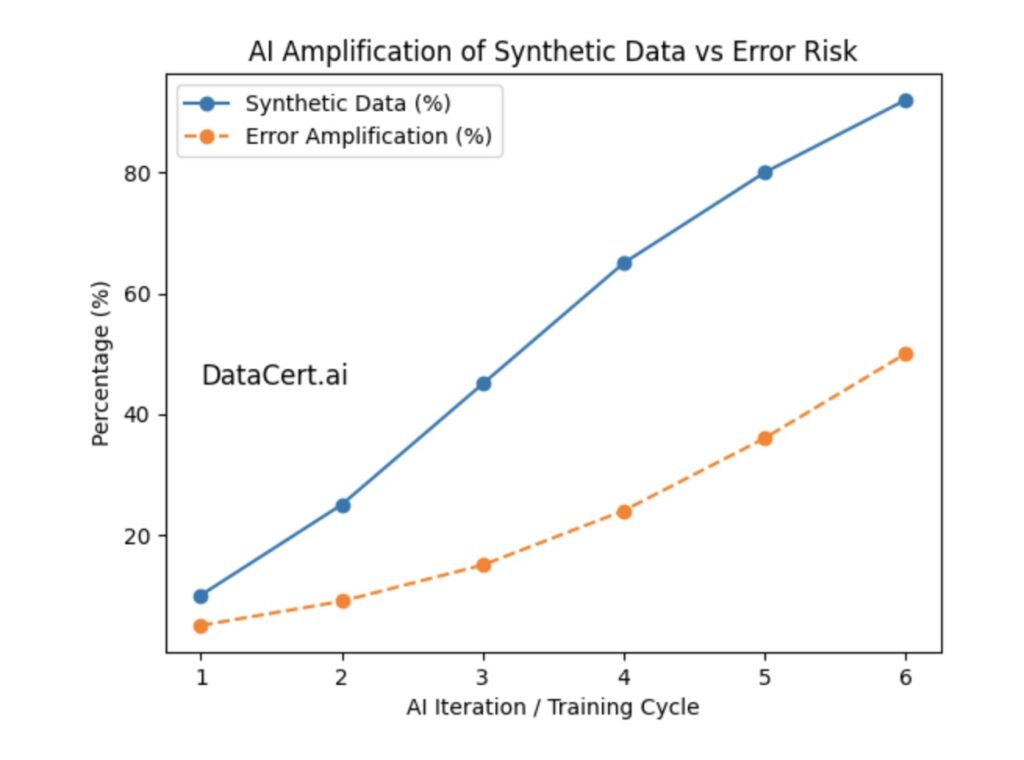
As AI systems scale, the question of what information they consume becomes critical. AI does not “know” truth in any meaningful sense. It processes inputs, recognizes statistical patterns, and generates outputs weighted by probability. That architecture has profound implications:
The core vulnerability: If the data AI consumes is corrupted, manipulated, or fabricated, AI does not detect the distortion. It learns from it. It scales it. It propagates it with confidence.
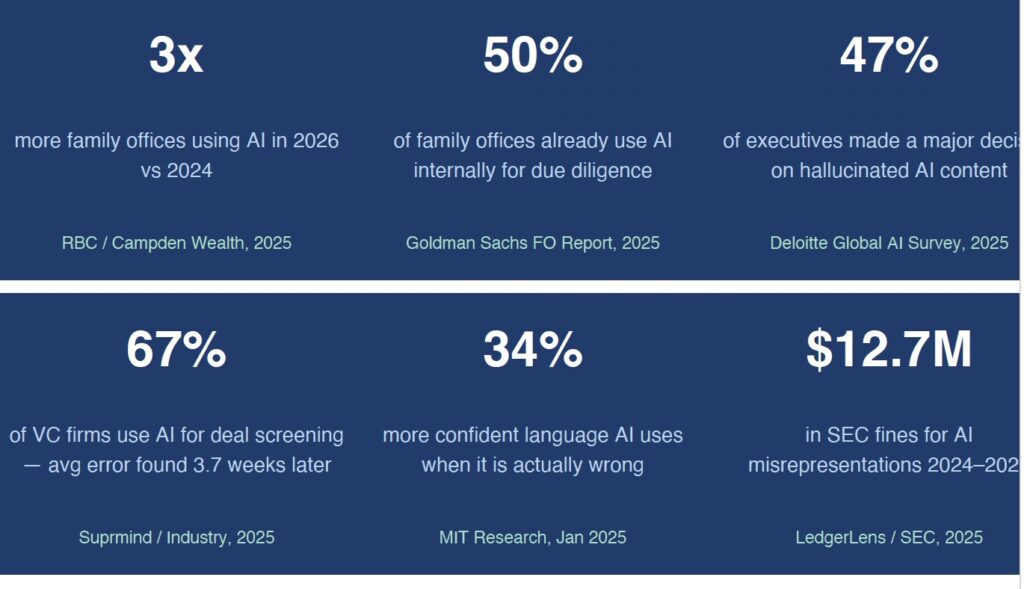
AI-generated, unverified data already influences financial markets, automation, and compliance.
The problem compounds as AI becomes more capable. A more powerful model trained on or consuming corrupted data produces more convincingly wrong outputs. The trust deficit in the underlying data layer becomes a systemic risk.
🛡️The Missing Layer: Cryptographic Provenance Infrastructure
This is the problem that Made in USA Inc. (OTC: USDW) — operating through Data Certify.ai — is architected to solve. Investor Information : (OTC: USDW)
The thesis is straightforward: in a machine-driven economy, truth cannot be assumed. It must be cryptographically verifiable, immutably anchored, and machine-readable. This is not a feature addition to existing systems. It is a new category of infrastructure.
The CertAnchor™ platform delivers this through a three-module verification architecture:
- Domain & IP Verification — authenticates the real-world origin of web-based content at the root level.
- TPM Identity & AI Readiness Scoring — establishes hardware-level device identity and evaluates systems against a 120-point AI data readiness standard
- Token Contract Proof — verifies the authenticity and integrity of on-chain digital assets.
All verification records are anchored immutably on the XRP Ledger — chosen for its deterministic finality, sub-second settlement, and negligible transaction costs at scale.
The XRP Ledger has undergone its own pivotal transformation in recent months. As explored in our earlier analysis — The Ruling Is Done: XRP’s Biggest Week Starts Now — the regulatory clarity achieved for XRP marks a structural inflection point for enterprise adoption. That clarity is precisely what makes XRPL the right foundation for institutional-grade verification infrastructure: it is now a legally unambiguous, high-throughput settlement layer that enterprises can build on with confidence.
🔗Why the XRP Ledger Is the Right Foundation
The choice of settlement layer matters enormously for verification infrastructure. A trust system is only as reliable as the ledger underpinning it.
The XRP Ledger was selected for this infrastructure for three reasons that compound each other:
- Finality without ambiguity — transactions settle in 3–5 seconds with cryptographic certainty, not probabilistic confirmation
- Cost efficiency at scale — fractions of a cent per transaction make high-frequency anchoring economically viable, not just technically possible
- Global, permissionless verifiability — any party, anywhere, can independently verify an anchored record without relying on a trusted intermediary.
This combination makes XRPL uniquely suited to serve as the immutable backbone of a machine-verifiable internet — one where provenance can be confirmed programmatically, in real time, by any system that needs it.
💰Verified Data as a Financial Asset
The infrastructure thesis extends beyond data integrity into capital markets. Once verification is cryptographically anchored and machine-readable, it becomes the foundation for a new class of financial primitives.
The roadmap for Made in USA Inc. (USDW) includes:
- Launching “Made in USA Stock” — a verified-provenance equity instrument tied to domestic production authenticity
- Introducing the USDW token — connecting verified supply chain and product data to on-chain financial activity
- Expanding CertAnchor™ to financial data workflows — enabling AI-assisted compliance, underwriting, and market analysis to operate on cryptographically verified inputs
This is the core value proposition: verified data is not just operationally safer; it is also more reliable. It is structurally more valuable. Markets that can trust the provenance of the information they act on will price that trust — and the infrastructure that enables it.
🚀The Full AI Stack: Where the Opportunity Actually Lives
A clearer picture of the AI economy is emerging — and it reveals where the most durable value creation will occur.
| Layer | Function | Where Markets Are Focused |
| ⚡ Energy | Power generation & grid delivery | Underweighted |
| 🔌 Electrical Infrastructure | Conversion, distribution, protection | Largely ignored |
| 🧠 Compute | GPUs, TPUs, model training | Heavily priced in |
| 🌐 Applications | Products, models, software | Heavily priced in |
| 🛡️ Trust Infrastructure | Provenance, identity, verification | Emerging — early stage |
The dominant market narrative has concentrated capital in compute and applications — the layers that are already well-understood and heavily competed. The asymmetric opportunities in this cycle lie in the infrastructure layers that make it all possible: energy delivery and verified trust.
✦The Defining Question of the AI Economy
The AI revolution will not be defined solely by the intelligence of the models we build.
It will be defined by three structural questions:
- Who controls the energy that keeps inference running at scale?
- Who builds the electrical infrastructure that connects AI hardware to the grid?
- And perhaps most fundamentally, who defines what is real?
In a machine-driven economy, truth cannot be assumed. It must be verified — cryptographically, immutably, and at the speed of markets.
That is the infrastructure gap. Made in USA Inc. (USDW), Data Certify.ai, and the CertAnchor™ platform are built to fill. Not as a feature. As a foundation.
This company is new, having been published recently.
So new, I expect that most investors have never even heard of it…