
An Investor’s Map to Crypto’s Great Consolidation
Ten headlines crossed the wire this week that look, on the surface, like they belong to ten different conversations: an Ethereum privacy startup coming out of stealth, a Korean exchange partnership, a Layer 2 founder’s public mea culpa, a prediction-market manipulation study, a DeFi liquidity report, a payments acquisition, a token unlock. Read one at a time, they are just news.
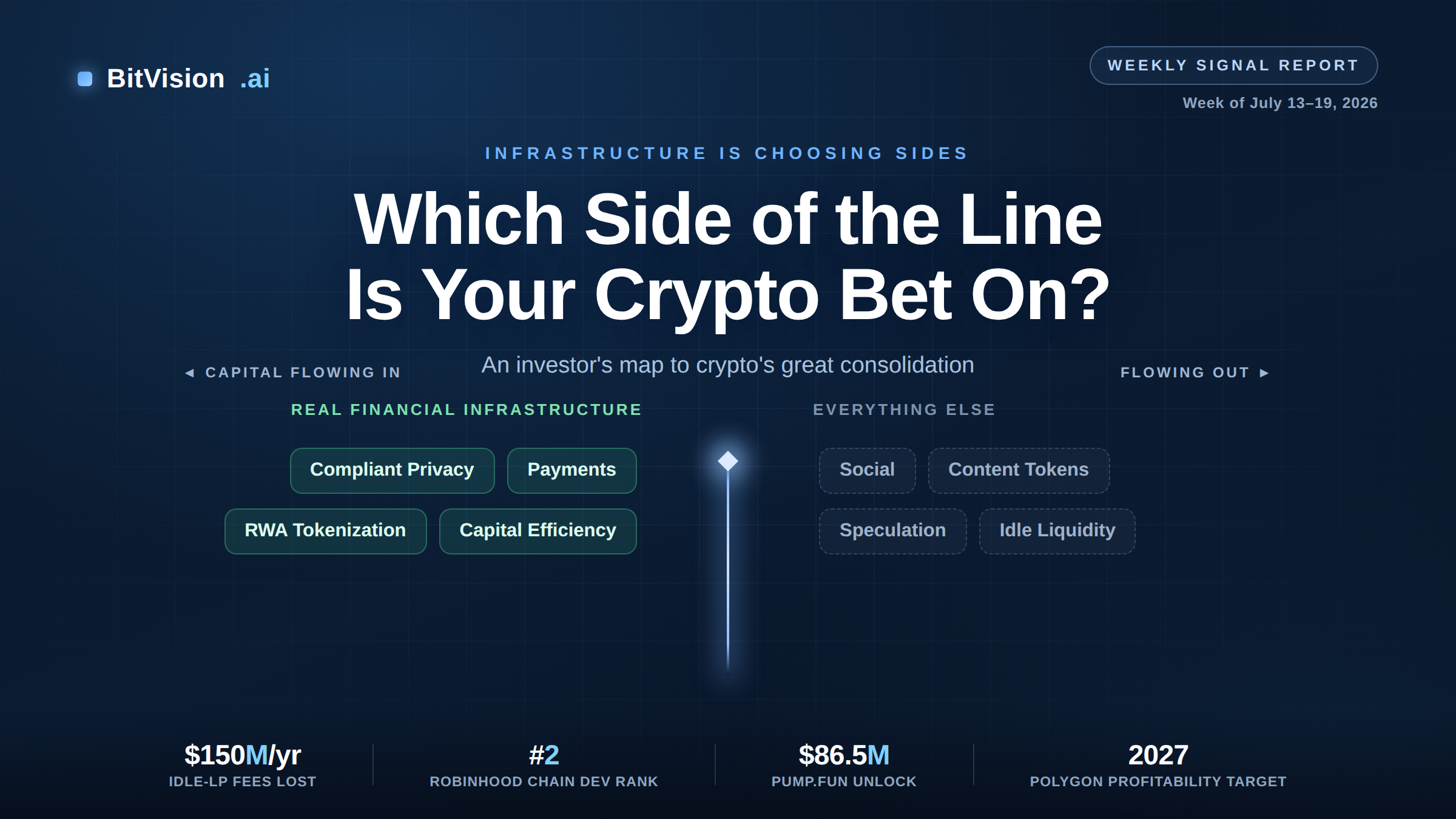
Read together, they draw a single line through the market. Every serious chain, protocol, and application is now being forced to choose a lane — real financial infrastructure on one side, everything else on the other — and the projects that chose wrong are already paying for it in developer share, revenue, and relevance.
For anyone allocating capital or screening new tokens, that line is the most useful filter in crypto right now. Here is the signal underneath the noise, and how to trade the map rather than the headlines.
1. Privacy Is Being Rebuilt for Compliance — Not Evasion
The week’s most strategically important launch was EthSystems, an institutional Ethereum privacy company backed by BitMine, SharpLink, SNZ Holding, and Ethereum co-founder Joseph Lubin. The team came directly out of the Ethereum Foundation’s Institutional Privacy Working Group, and the product thesis is explicit: let banks and asset managers transact on Ethereum without broadcasting counterparty identities and trade sizes to competitors on a public ledger.
In the same window, Starknet shipped STRK20, a compliant privacy framework for ERC-20 assets. Users are screened before entering privacy pools, transactions are encrypted by default, and disclosure occurs only in response to a valid legal request. That is a deliberate architecture — auditable-on-demand privacy, not anonymity.
Why this matters for allocation. The “privacy coin” narrative of 2017–2021 was priced around evading oversight, and it aged badly precisely because regulators treated it as a threat. This generation of privacy infrastructure is being engineered to satisfy oversight — screening, selective disclosure, lawful-request compliance baked in at the protocol layer. That is the difference between a product regulators tolerate and one they actively route institutional flow through. When you screen a privacy or identity project today, the first question is no longer “how private is it?” but “does its privacy survive a subpoena?” The ones that answer yes are riding the same wave EthSystems and Starknet are validating with real institutional capital behind them; the ones built for pure secrecy are a shrinking, higher-risk bet.
2. The L2S Are Abandoning “Social” and Racing Toward Trading, Payments, and RWAs
This is the loudest signal of the week, and it came from the source. Base founder Jesse Pollak publicly admitted that the network’s early-2026 bets on social products and content tokens were a strategic mistake that left Base behind in perpetuals, prediction markets, tokenization, and payments. The consumer-facing Base App has been handed back to Coinbase, and Pollak is now committing the year to three verticals only: trading, payments, and AI agents — stablecoin rails, tokenized equities, and economic activity built for agents rather than for feeds.
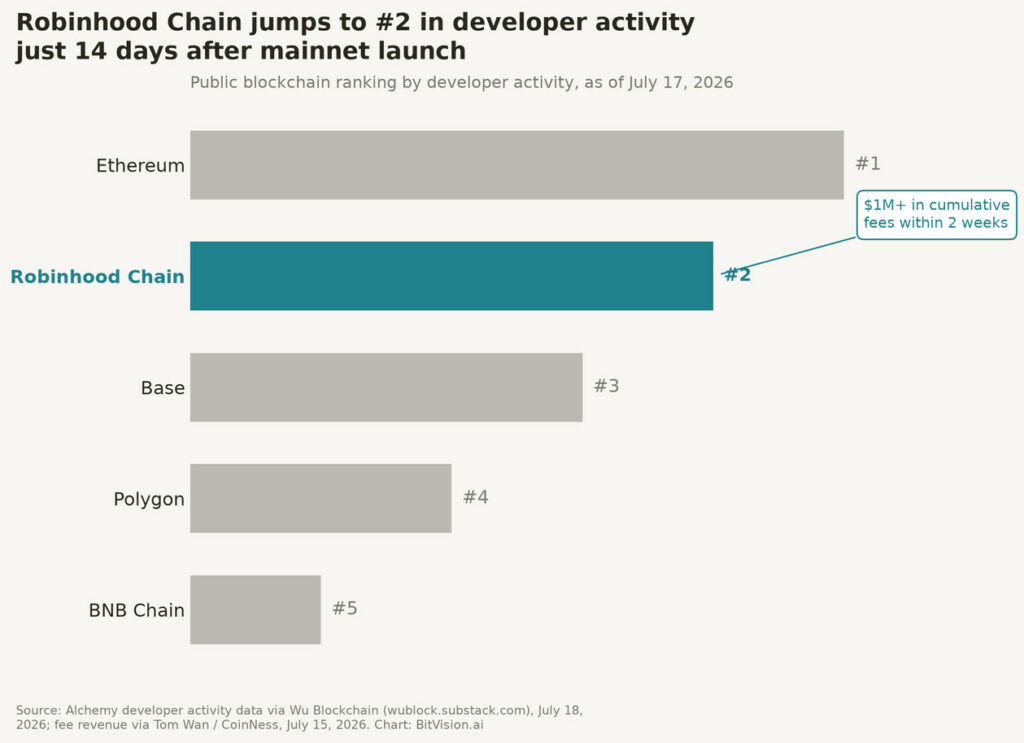
At the same time, Optimism is expanding into South Korea through Dunamu (operator of Upbit), Toss, and DB Securities — not for social features, but to build won-denominated financial infrastructure and tokenize real-world assets, reportedly down to Jeju Island agricultural and livestock assets. And Robinhood Chain, roughly two weeks after mainnet, has already climbed to second place in developer activity behind only Ethereum, with more than $1 million in cumulative fee revenue — currently driven by meme coins and launchpads, but sitting on a brokerage’s existing rails and retail user base.
Why this matters for allocation. The market just ran a live A/B test with real money and real developer-years. Base spent roughly a year on social and lost ground to competitors building perps, prediction markets, and stablecoin payments. Optimism and Robinhood Chain are skipping the social detour and going straight at RWA tokenization and brokerage-native products. When you screen an L2 or infrastructure position, the current evidence favors chains that explicitly build payment rails, tokenized assets, and agent-native economic activity over anything that chases social or content virality. You don’t have to infer this — the founder of the largest chain that tried the other path said it in public. The nuance worth respecting: Robinhood Chain’s early volume is still meme-driven, so treat “developer activity” and “fee revenue” as leading indicators of a distribution channel, not yet proof the financial use case has arrived.
3. Polygon’s Pivot Confirms the Pattern — and Prices In the Cost
Polygon Labs is cutting staff while finalizing its acquisition of Coinme, with CEO Marc Boiron framing the move as a transformation from “blockchain foundation” to “blockchain payment firm” targeting profitability by 2027. He is careful to note this is structural, not performance-driven — a deliberate reorientation toward payments even as stablecoin volumes set records.
Why this matters for allocation. Polygon reinforces the same thesis from the operator’s chair rather than the founder’s microphone. The chains most likely to survive this cycle are not necessarily the ones with the highest TVL or the most generous ecosystem grants — they are the ones restructuring their entire operating model around payments and real financial rails, even when that means shrinking headcount to fund it. A useful leading indicator falls out of this: watch for Coinme-style fiat on/off-ramp acquisitions. When an L1 or L2 buys a regulated ramp, it is telling you it intends to become payment infrastructure rather than a developer playground — and that is a screenable, dateable event, not a vibe.
4. Market-Integrity Cracks Are Appearing Exactly Where Speed Meets Size
Two stories this week are less about strategy and more about warning lights on the dashboard. A Stanford / Singapore Management University working paper found evidence that traders are placing concentrated, one-sided orders on Binance in the final seconds before Polymarket’s five-minute BTC prediction markets settle — nudging the reference price in their favor before it resets. Separately, Pump.fun completed its first team-and-investor token unlock, distributing roughly $86.5 million across 121 wallets as a three-year vesting schedule begins.
Why this matters for allocation. These are two flavors of the same risk: market structure that was never designed for the size or speed of the capital now flowing through it. Ultra-fast settlement windows create a manipulation surface that simply did not exist when these products launched small and illiquid. Large unlocks concentrated in a handful of wallets create a short-term supply shock risk regardless of how strong the underlying protocol is. Both belong on your due-diligence checklist as standing flags, not one-off headlines — track unlock schedules and settlement mechanics with the same rigor you would apply to a founder background check. And note the deeper lesson the Polymarket study delivers: on-chain transparency alone does not eliminate manipulation. Verifiable data is necessary, but it is the design around the data — settlement windows, oracle sourcing, disclosure — that determines whether a market can be gamed.
5. DeFi’s Oldest Inefficiency Finally Has a Price Tag — and a Counter-Move
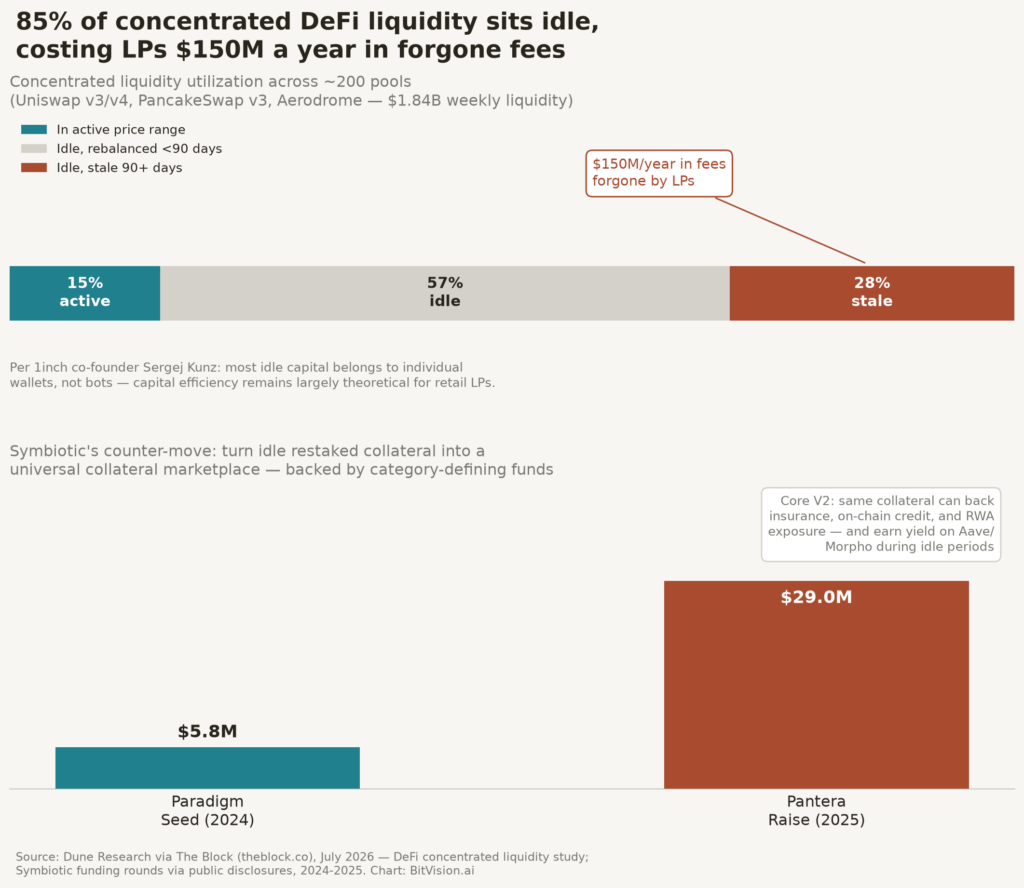
Dune’s research across roughly 200 pools on Uniswap v3/v4, PancakeSwap v3, and Aerodrome — covering about $1.84 billion in weekly liquidity — found that roughly 85% of concentrated liquidity sits outside its active price range at any given moment, costing liquidity providers an estimated $150 million a year in forgone fees. More than a third of that idle capital hasn’t been rebalanced in 90+ days, and according to 1inch co-founder Sergej Kunz, most of it belongs to individual wallets, not bots. Concentrated liquidity’s core promise — capital efficiency — is still largely theoretical for retail LPs, even with Uniswap v4 Hooks live.
The counter-move is Symbiotic’s Core V2, which turns restaked collateral into a “universal collateral marketplace”: the same asset can simultaneously back insurance, on-chain credit, and RWA exposure, and be deployed into lending venues like Aave or Morpho during idle periods. Symbiotic has raised from Paradigm ($5.8M seed, 2024) and Pantera ($29M, 2025) — two funds with a track record of backing infrastructure that later becomes category-defining.
Why this matters for allocation. The Dune data quantifies a $150M/year inefficiency that has been an open secret in DeFi for years, and it isn’t self-correcting because retail LPs lack the tooling to actively manage ranges. That is a real, size problem hunting for a structural solution — and capital efficiency, not another AMM, is where the next competitive edge in DeFi is likely to accrue. Symbiotic’s collateral-reuse thesis is one of the more credible attempts to solve it at the base layer rather than through better dashboards. Track it as a category, not a single ticker: institutional allocators care about capital utilization above almost everything else, which makes this one of the more durable long-term themes on the board.
The BitVision.ai Read: One Line, Two Sides
Strip away the tickers and this week resolves into a single macro signal. Capital, developer talent, and regulatory goodwill are all consolidating on one side of a line — compliant privacy, payments, RWA tokenization, and capital-efficient collateral — and draining away from the other: social, content, and unmanaged, speculative liquidity. Base’s founder said it out loud. Polygon is rebuilding its entire company around it. Optimism and Robinhood Chain are building for it from day one. And the two integrity stories — Polymarket and Pump.fun — are reminders of what breaks when speed and size outrun the market structure beneath them.
There is a quieter connective thread running under all five stories, and it is the one worth internalizing if you build or allocate in this space: every item on the “winning” side of that line is ultimately a bet on verifiable trust. Compliant privacy is selective disclosure — proving what must be proven, hiding the rest. RWA tokenization only works if the issuer, the asset, and the wallet on the other side can actually be verified. The payments pivot is a bet that regulated counterparties will transact once identity and provenance are cheap to establish. Even the integrity failures are verification failures — a reference price no one can vouch for, a supply schedule buried until it moves the market. The projects clearing regulatory bars are not simply “more private” or “more scalable”; they are more checkable. In a market this reflexive, checkability is becoming the moat.
So the investor’s checklist got shorter and sharper this week. For any new token or infrastructure bet, ask three questions and let the answers sort it:
- Which side of the line does this sit on — real financial infrastructure, or the social/content/speculation side Base just spent a year proving doesn’t hold?
- Does its design survive scrutiny — a subpoena, an audit, a settlement-window stress test, a fully diluted unlock schedule?
- Can its core claims be verified by someone who isn’t trusting the team — the issuer, the collateral, the counterparty, the reference price?
The question is no longer whether institutions will use blockchains. It is which ecosystems will provide the privacy, compliance, efficiency, and — above all — the verifiability they require. This week, several of them raised their hands. The rest are now on the wrong side of a line their own peers are drawing.
Analysis by BitVision.ai. This piece is market commentary for informational purposes and is not investment advice. Figures are drawn from the cited primary reports; verify current data before acting.
Sources: EthSystems launch (B2i); Starknet STRK20; Optimism–Dunamu / Toss / DB Securities (Decenter); Robinhood Chain developer-activity and fee data; Jesse Pollak / Base strategy statements; Marc Boiron on Polygon–Coinme; Stanford/SMU working paper on Polymarket settlement (via Bloomberg); Pump.fun unlock disclosures; Dune Analytics DeFi liquidity report (via The Block); Symbiotic Core V2 and funding history.