
Slug: /clarity-act-institutional-capital-ionization Meta description (154 chars): The CLARITY Act isn’t about XRP’s price. It’s about whether pensions, insurers and banks get statutory permission to build on-chain. Here’s what’s at stake. Deck: Wall Street has already endorsed it. The technology already works. What’s missing is a law — and seven Senate votes.
The state of play, in one paragraph
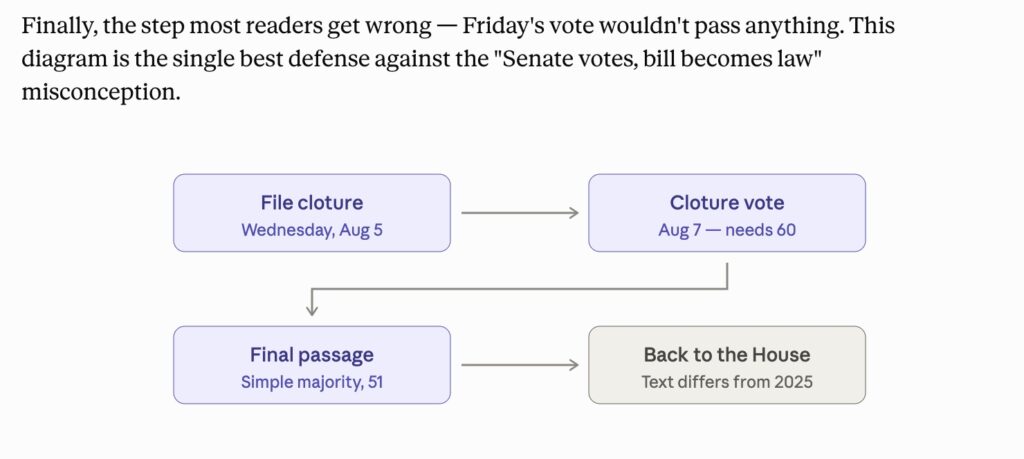
The Digital Asset Market Clarity Act — H.R. 3633, Calendar No. 423 — has been eligible for a Senate floor vote since June 1 and has not received one. Majority Leader John Thune said again on August 3 that he expects a vote this week. As of that statement, no cloture motion had been filed, and the bill was absent from the floor calendar. Under ordinary Senate rules, a petition filed Wednesday, August 5 produces a Friday, August 7 vote — and that vote would only end debate on the motion to proceed, not pass anything. The Senate’s last session day is August 7. It returns September 14. Prediction markets put 2026 passage near 30%, down from above 80% in February.
That’s the news. Here’s why it matters far more than the price action suggests.
The real question: who gets permission to build
Strip away the politics, and CLARITY answers one question: is a token a security or a commodity, and who says so—an agency or Congress?
In March 2026, the SEC and CFTC issued joint interpretive guidance classifying sixteen digital assets, including Bitcoin, Ether, Solana and XRP, as digital commodities. That was the answer institutions had waited a decade for. And yet the institutional bid has been muted. XRP sits near $1.08, down roughly 41.5% year-to-date. Bitcoin is in the low-to-mid $60,000s.
Why didn’t the guidance unlock the capital?
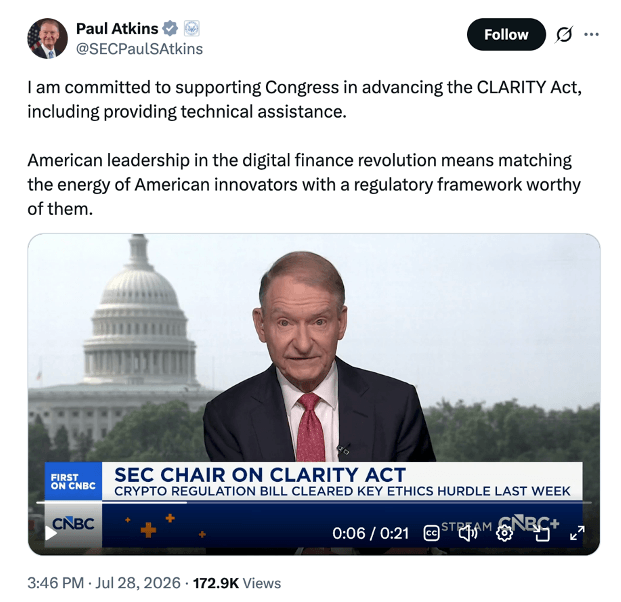
Because guidance is revocable and statute is not. A future administration can withdraw a joint interpretation without a vote in Congress. SEC Chair Paul Atkins said the quiet part out loud on July 27: the agency is “ready, willing and able” to write rules if Congress fails — while stressing that statute is how you future-proof a framework. He is arguing for his own obsolescence, which is unusual enough to be worth taking seriously.
This is the distinction that determines whether capital moves, and it’s a verification problem before it’s a political one. An attestation that depends on the continued goodwill of whoever currently controls the registry is a fundamentally weaker object than one anchored in something no single party can unilaterally rewrite. Institutions understand this instinctively, and their mandates encode it.
Which institutions, and what unlocks
“Institutional adoption” is a phrase that has lost meaning. Here’s the specific mechanism.
| Public pensions | Investment policy statements typically bar assets without settled legal classification; trustees carry personal fiduciary exposure | Codified commodity status converts a governance debate into an asset-allocation decision |
| Insurers | State regulators (NAIC) set capital charges by asset class; unclassified assets attract punitive treatment or outright exclusion | A statutory class is a prerequisite for a defined risk-based capital charge |
| Sovereign wealth funds | Political risk of allocating into a framework a foreign administration can reverse | Removes reversal risk from the underwriting memo |
| Banks | Uncertainty over whether digital-asset activities are permissible; capital treatment unresolved | CLARITY authorizes specified digital-asset activities for regulated institutions |
| ETF issuers | Product expansion beyond BTC/ETH depends on classification holding | Widens the eligible universe for spot and index products |
| Custody providers | Qualified-custodian status for digital assets remains interpretive | Statutory registration standards for custodians, brokers, dealers |
This is why BlackRock, Fidelity, Franklin Templeton, Goldman Sachs, Charles Schwab and SoFi all endorsed the bill in late July. They are not asking for a favor. They are asking for the legal predicate their own compliance departments require before they can scale products they have already built.
One caveat worth naming: Wall Street is not unified. JPMorgan and the American Bankers Association back stablecoin yield restrictions that Coinbase and much of the crypto industry oppose. The endorsement column is real; the commercial fight underneath it is unresolved.
What actually changes if it passes
The technology stopped being the bottleneck a while ago. Look at what’s been built without a law:
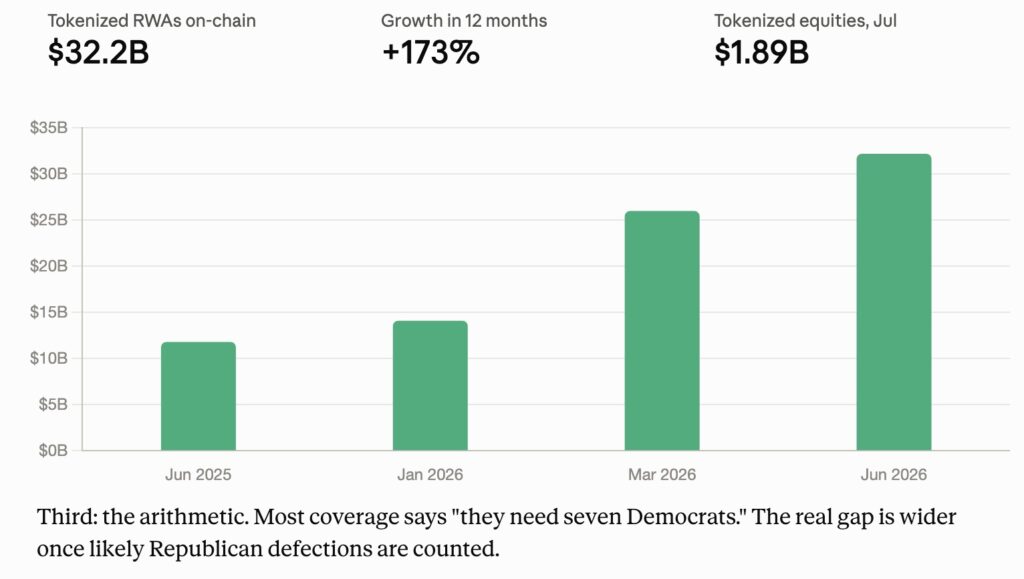
- Tokenized RWAs reached $32.2 billion on-chain by the end of June 2026, up from roughly $11.8 billion a year earlier — nearly tripling in twelve months. Tokenized US Treasuries lead at ~$15 billion.
- Tokenized equities roughly doubled from $951 million in March to $1.89 billion in July. Kraken’s xStocks platform cleared $25 billion in cumulative volume in about eight months and now lists a tokenized SpaceX equivalent.
- The plumbing is arriving anyway: the SEC advanced Nasdaq’s proposal for tokenized stock trading and settlement in March. DTCC’s tokenization pilot is slated for October. Securitize listed on the NYSE at a $1.25B valuation and tokenized its own stock on listing day. Robinhood launched an L2 purpose-built for tokenized equities.
Standard Chartered’s Geoff Kendrick projects assets deployed in DeFi could reach $2.7 trillion by 2030. Every one of those forecasts embeds an assumption about regulatory permanence.
Sector-by-sector, passage would move:
- Tokenized equities and RWA platforms — Ondo, Securitize, Robinhood, DTCC, Nasdaq. The largest beneficiaries are those whose addressable market is gated by whether pension and insurance capital can legally participate.
- Stablecoins and payments — GENIUS already governs issuance. CLARITY governs the market structure around it. Together they complete the rails.
- Custodians and banks — statutory registration standards convert pilots into product lines.
- Exchanges — a federal registration regime replaces the fifty-state money-transmitter patchwork and enforcement risk.
- Infrastructure and protocol developers — this is Section 604, and it deserves its own paragraph.
Section 604 — the Blockchain Regulatory Certainty Act — establishes that a developer or infrastructure provider who cannot move or control a user’s assets is not a money transmitter under federal law—no Bank Secrecy Act registration for publishing non-custodial code. Coin Center and the Blockchain Association call it non-negotiable; industry counsel warn that stripping it invites a First Amendment challenge over treating code publication as regulated financial activity. Several law enforcement groups oppose it as an exploitable gap. Two of the seven swing Democrats — Warner and Cortez Masto — have tied their votes to law enforcement’s position on it.
So Section 604 is load-bearing in both directions: it’s the provision builders most need, and the one most likely to be traded away to buy the votes.
The part nobody is writing about: what this means for AI agents
BitVision readers are here for the intersection, so let’s be precise about it.
Autonomous agents transacting value — routing payments, settling machine-to-machine invoices, managing treasury operations, paying for compute or data by the API call — run into three legal questions that no current framework answers cleanly:
- Is an agent that routes value a money transmitter? Section 604’s non-custodial test is the closest thing in US law to an answer. An agent that cannot unilaterally control user funds looks like the software it is. Strip 604, and every agentic payment framework in the country inherits BSA exposure by default.
- What is the settlement asset? GENIUS settled stablecoin issuance. CLARITY would settle the market structure around trading and custody. Agentic commerce needs both legs, and they need to be durable — an agent architecture is a multi-year capital commitment, not a quarterly trade.
- How does an agent verify its counterparty? This is the question CLARITY does not answer, and it’s the one that matters most. Legal classification tells you what an asset is. It doesn’t tell you whether the wallet, domain, or entity on the other side of an autonomous transaction is who it claims to be.
That third gap is the honest reading: CLARITY makes machine-to-machine settlement legally addressable, not operationally trustworthy. Verifiable domain and wallet attestation, on-ledger KYB, and cryptographic entity binding remain the missing layer regardless of how the Senate votes. If anything, passage increases demand for that layer because a legal regime with defined registration obligations creates a compliance requirement where there is currently only a best-practice standard.
That is the second-order effect worth positioning around — and it doesn’t depend on Friday.
The global race, and where the US actually sits
- EU — MiCA is fully live, its transitional period now closed across member states. Ripple holds a full MiCA license. Twenty-seven markets, one rulebook.
- Hong Kong — the SFC published a secondary trading framework in April 2026 and has approved real estate tokenization products, as well as a stablecoin licensing regime and tokenized government bond issuance.
- Singapore — MAS runs Project Guardian and one of the most institutionally credible digital asset regimes globally.
- UAE — Dubai’s Land Department opened the second phase of its property tokenization program in February 2026, enabling resale of tokenized units.
- Switzerland and the UK — FINMA licensed DLT trading facilities; the Bank of England’s Digital Securities Sandbox continues to expand.
The US position is genuinely unusual: the deepest capital markets in the world, the largest asset managers, the most advanced tokenization infrastructure — governed by an interpretation rather than a statute. That’s not a competitiveness talking point; it’s an arbitrage. Cross-border tokenized products currently incur compliance costs specifically because the US leg is the least settled.
If it fails
Nothing breaks on August 10. No exchange, token, or stablecoin faces legal jeopardy if the window closes. GENIUS implementation continues. The SEC’s Project Crypto proceeds — Regulation Crypto is on the 2026 agenda, covering token registration exemptions, a decentralization safe harbor, broker-dealer custody and trading venues. Atkins has said he’ll write the rules.
What changes is the trajectory. A failed window pushes comprehensive market structure into a compressed September calendar, competing with spending deadlines, and, realistically, into mid-2027. The framework stays revocable. The institutions in the table above continue to wait. And the tokenization growth curve keeps compounding offshore, in jurisdictions that finished this work years ago.
The vote math, compressed.
Republicans hold 53 seats; 60 is the gate. Hawley and Paul are expected to oppose on substance, putting the usable GOP base near 51 — so the real ask may be nine Democrats, not seven.
On July 22, seven Democratic negotiators — Cortez Masto, Alsobrooks, Booker, Gallego, Hickenlooper, Warner, Warnock — said the Republican text “falls short” on ethics, consumer protection, illicit finance, conflicts of interest and market integrity. They did not walk away. But they are the same seven votes the bill needs; there is no reserve bloc. The current Republican ethics provision carries DOJ-only enforcement and a 2029 sunset, which Alsobrooks has called unserious given that the Attorney General serves at the president’s pleasure.
Hard no: Warren, Murphy, Van Hollen, Merkley.
Scenarios and pricing
Spot as of August 4: XRP ~$1.08 (−41.5% YTD), BTC low-to-mid $60,000s, ETH ~$1,860, total market cap ~$2.16T. Polymarket ~30% on 2026 passage; Galaxy Research cut its estimate from 50% to 30% this week.
Demonstrated sensitivity: on July 21, a reported ethics agreement — not a filing, not a vote — broke XRP through the $1.13 ceiling that had capped every rally since late June, to an intraday $1.1511 and a 3.5% session gain, with roughly $2.93M in leveraged short liquidations. Bitcoin cleared $66,000. That’s the observed beta on a headline, which tells you the positioning here is fast and crowded.
| Cloture invoked, bill passes | $1.60–2.20 | Still needs bill cloture, passage, House reconciliation |
| Passage + ETF inflows + softer Fed | $2.50–3.50 | The only path that codifies commodity status |
| Slips to September (base case) | Drift; $1.00 support tested | Compressed calendar, midterm politics |
| Dies for 2026 | $0.80–1.00 | SEC Plan B proceeds; framework stays revocable |
Roughly 830 million XRP sits concentrated near $1 as support, with thin bid density between $1.00 and $0.80. The ranges above are third-party estimates based on a ~$1.13 reference — directional framing, not targets.
What to watch
- Wednesday, Aug 5 — does a cloture petition on H.R. 3633 appear on the Senate cloture ledger? Binary. No filing, no vote.
- Any day — do the seven Democratic negotiators replace “falls short” with anything affirmative? Watch Alsobrooks and Gallego; they moved first in committee.
- Section 604 — does it survive the compromise intact? This is the provision that matters most for builders and agentic infrastructure, and the most likely bargaining chip.
- October — DTCC’s tokenization pilot launches regardless of the vote. The infrastructure is not waiting for Congress.
The bill is a permission slip, not a technology unlock. The technology already works. What’s being decided this week is whether the largest pools of capital on earth are legally allowed to use it — and whether that permission is written in ink or pencil.