
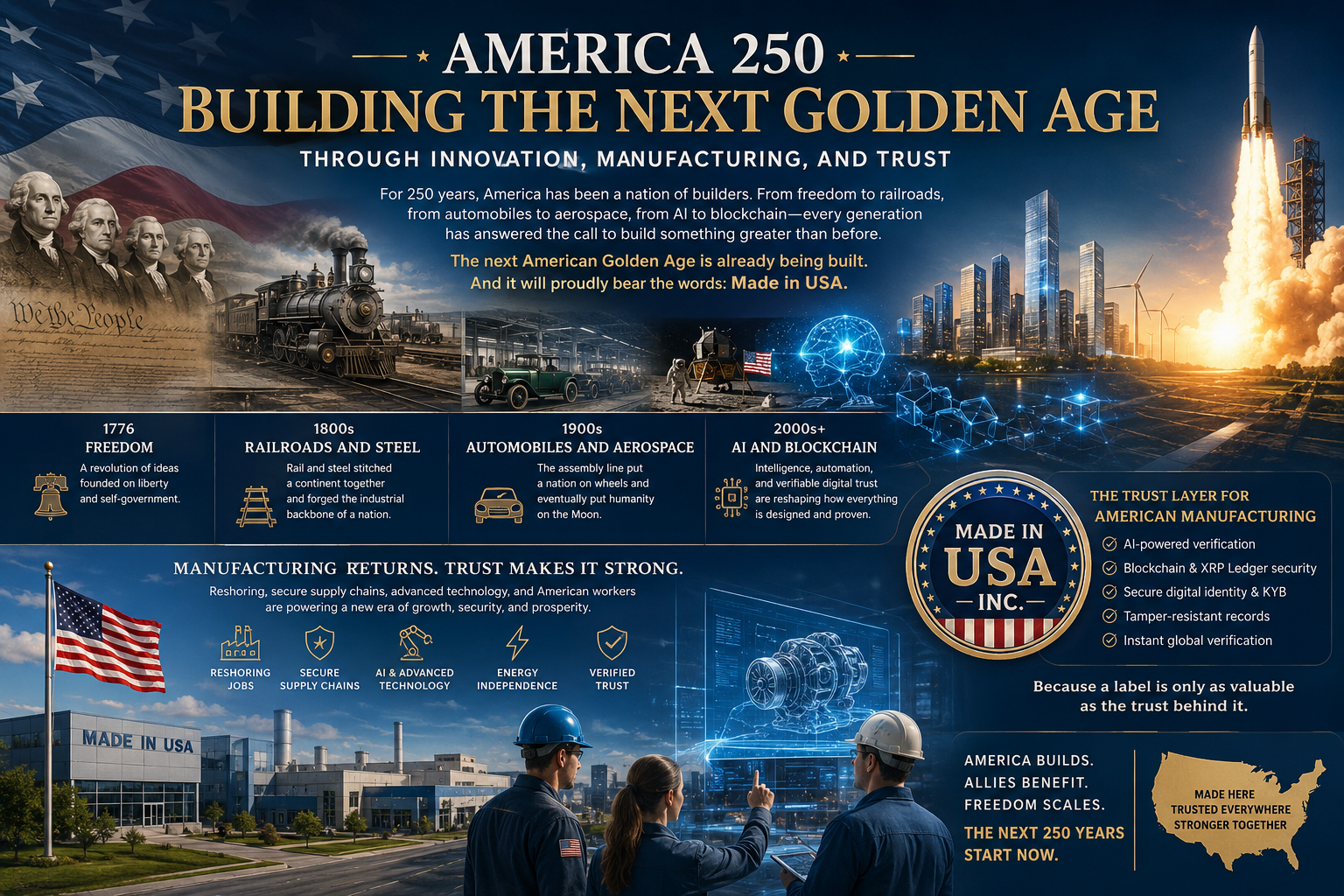
Through Innovation, Manufacturing, and Trust
For 250 years, America has been a nation built by visionaries. From the Founding Fathers who drafted the Constitution, to the industrial pioneers who connected a continent by rail, to the scientists who put humanity on the Moon, every generation has answered the same challenge: build something greater than what came before.
The story of America has never been one of standing still. It is the story of builders and inventors, of entrepreneurs and engineers, of farmers, manufacturers, soldiers, and workers whose determination transformed a young republic into the world’s leading economic and technological power. That momentum was never inevitable. It was earned—decision by decision, factory by factory, invention by invention.
As the United States celebrates its 250th anniversary, we honor not only our history but the extraordinary opportunity in front of us: to build the next American Golden Age.
Four Revolutions, One Continuous Story
America’s greatness is best understood as a single arc told across four industrial revolutions. Each was powered by a different technology, but all were driven by the same conviction—that tomorrow could be built larger than today.
- 1776 — Freedom. A revolution of ideas gave the world a nation founded on liberty and self-government—the operating system on which everything else would be built.
- 1800s — Railroads and Steel. Rail and steel stitched a continent together, moving people, goods, and ambition at a scale never before possible, and forging the industrial backbone of a rising power.
- 1900s — Automobiles and Aerospace. The assembly line put a nation on wheels and eventually put humanity on the Moon, as American manufacturing and aerospace defined the modern age.
- 2000s — Artificial Intelligence and Blockchain. Intelligence, automation, and verifiable digital trust are now reshaping how everything is designed, produced, and proven—the fourth revolution, and the one still being written.
Seen this way, the present moment is not a break from history but its continuation. The same builder’s instinct that laid rail and launched rockets is now training models, securing ledgers, and reshoring factories. The tools change; the character does not.
Learning From the Past
To build wisely, we first have to read the record honestly. Over the past several decades, America lived through one of the largest economic shifts in its history. Manufacturing moved overseas. Critical supply chains grew dependent on foreign production. Thousands of factories closed, millions of skilled jobs disappeared, and communities that once powered American industry were left to absorb the loss.
The consequences reached well beyond any single balance sheet. As production migrated, so did expertise. Losing a factory is not only losing a building—it is losing the engineers, technicians, and institutional know-how that make the next generation of products possible. Over time, the United States ceded leadership in a range of critical technologies while global competitors invested aggressively in advanced manufacturing, industrial capacity, and strategic infrastructure.
The lesson is not one of decline but of vigilance. Economic strength, technological leadership, and national security are not permanent endowments. They are renewable—but only when a nation chooses to renew them.
A New Era of American Dynamism
Today, a powerful transformation is under way. Across the country, entrepreneurs, engineers, investors, manufacturers, and policymakers are working—often together—to rebuild America’s industrial foundation. This movement has a name: American Dynamism—the conviction, championed by investors such as David Ulevitch of Andreessen Horowitz, that America is fundamentally a nation of builders, and that the country’s hardest and most important problems are once again worth building for.
The thesis is straightforward, and it reinforces a truth as old as the republic. America is a nation of builders. When America builds, its allies benefit. Technology determines who sets the standards the rest of the world must follow. And freedom scales through innovation—each breakthrough widening the space in which free people can live and trade. These ideas are not slogans; they are a strategy.
The proof is no longer theoretical. A new generation of companies is building in the physical world at frontier speed. SpaceX has made America the world’s launch provider and reopened the path to the Moon and Mars. Palantir Technologies has turned data into decisive advantage for enterprises and national defense. Anduril Industries is rebuilding the defense industrial base with autonomy and software at its core. These are not white papers; they are factories, launch pads, and production lines—evidence that the next American industrial era is already under construction.
The pace itself is the story. What once took decades can now take a few years. Modern design tools, automation, and digital infrastructure compress the distance between an idea and a finished product, so new companies move from concept to production faster than ever—creating high-paying careers while restoring American competitiveness. Speed, once a luxury, has become a strategic advantage.
The future belongs to those who build.
The Great Reshoring
Nowhere is this shift more consequential than in the return of production to American soil. After decades of offshoring, the tide is reversing—driven by hard lessons about fragility and a clear-eyed view of what economic security actually requires.
The themes reshaping capital and policy alike are concrete: factories returning to America and near-shoring to trusted partners; secure, transparent supply chains that cannot be quietly compromised; domestic semiconductor production to end dependence on foreign fabs for the chips that run everything; the AI infrastructure—data centers, compute, and power—on which the next economy will run; and energy independence to fuel it all. Together these are among the defining investment and industrial themes of the decade.
Reshoring is not nostalgia for a lost era. It is a forward bet that resilience, proximity, and trust are now sources of competitive advantage rather than costs to be minimized.
Manufacturing Must Be Trusted
Bringing production home is only part of the mission. Consumers, businesses, government agencies, and global trading partners also need confidence that a product claiming to be American genuinely meets the standard it advertises.
This is where the argument turns. In a global marketplace, a label is only as valuable as the verification behind it. When “Made in USA” can be claimed without proof, the honest manufacturer competes on uneven ground and the consumer is left to guess. Trust, in other words, has become as valuable as manufacturing itself—and it must be built with the same rigor. That is why verification, transparency, and traceability are becoming essential pillars of the modern economy, not optional marketing features. If technology determines who sets standards, then whoever builds the infrastructure of trust will help set the standards for global trade itself.
Made in USA Inc.: The Trust Layer for American Manufacturing
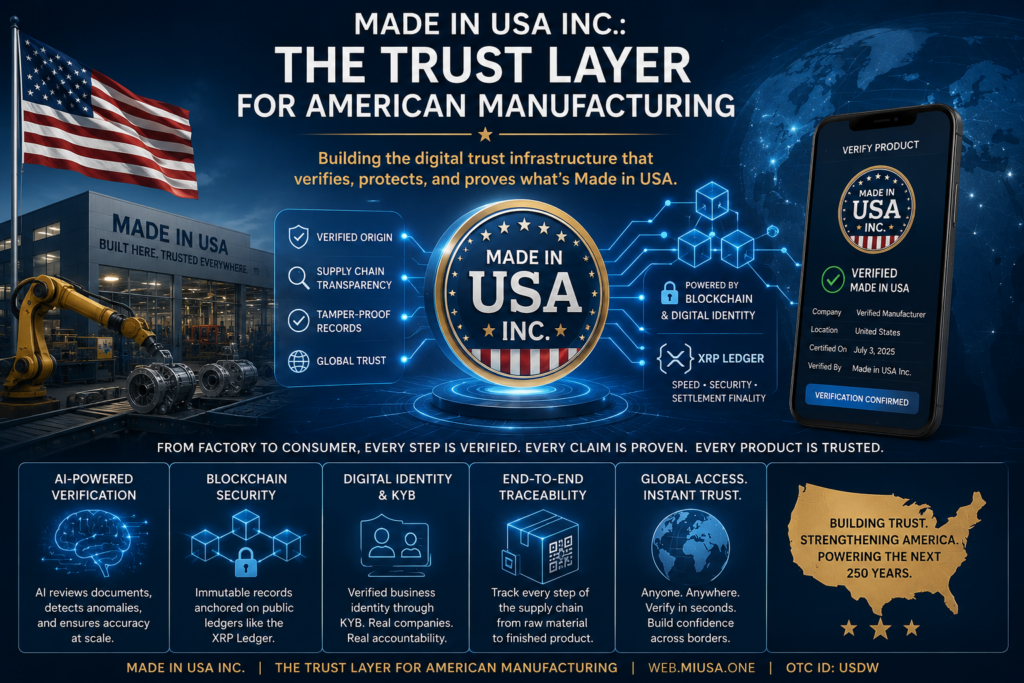
As America enters its next industrial revolution, Made in USA Inc. (web.miusa.one; OTC ID: USDW) is building something larger than a certification service. It is building the digital trust infrastructure for American manufacturing—the layer on which verified origin, authenticity, and accountability can be established for any product, by anyone, anywhere.
Today, manufacturers can verify and certify products that meet Made in USA and Product of USA standards. But the deeper ambition is infrastructural. The approach treats trust as an engineering problem: by integrating artificial intelligence, blockchain, secure digital identity, supply-chain verification, and tamper-resistant records, Made in USA Inc. is building a system where a claim of origin is backed by cryptographic evidence rather than assertion.
Each layer does distinct work. Artificial intelligence reviews documentation and flags inconsistencies at scale. Distributed-ledger technology—including the speed and settlement finality of ledgers such as the XRP Ledger—anchors certification records so they cannot be quietly altered after the fact. Secure digital identity binds a certificate to a verified business through know-your-business (KYB) checks, tying a domain, wallet, or online account to a real, accountable organization. Together, these controls turn a certificate into something a buyer can independently confirm in seconds.
Every American-made product should one day carry a digital certificate that anyone in the world can verify instantly.
That is the shift in perspective that matters. The point is not merely to certify today’s product; it is to build the standard on which tomorrow’s trade depends. Read narrowly, this is a company that certifies products. Read correctly, it is the digital trust layer for American manufacturing—infrastructure aligned with the deepest currents of AI, blockchain, digital identity, and the future of global commerce.
A verified product, then, represents far more than compliance. It represents integrity. It represents accountability. It represents pride in American craftsmanship. As consumers and trading partners increasingly demand proof rather than promises, verifiable trust will become a genuine competitive advantage—at home and abroad.
Technology and Manufacturing, Together
America’s next chapter will not be written by technology alone, nor by manufacturing alone. It will be written where the two meet.
Artificial intelligence will optimize production. Blockchain will strengthen trust. Digital identity will authenticate supply chains. Advanced robotics will improve productivity. And American workers will once again make the products that power the economy. None of these forces is sufficient on its own—but combined, they form an industrial ecosystem greater than the sum of its parts.
That ecosystem creates opportunity broadly: for engineers and software developers, for the skilled trades and factory workers, for veterans, researchers, entrepreneurs, and small businesses in every region of the country. Rebuilding industry is, at its core, rebuilding the ladder that lets people rise.
Freedom Through Innovation
America’s influence has always extended beyond its borders. When America innovates, global industries evolve. When America builds, its allies benefit. When America leads technologically, freedom itself grows stronger—because freedom scales through innovation.
These threads are connected. Economic independence supports national security. Resilient domestic manufacturing strengthens supply chains. Trusted products reinforce consumer confidence. And innovation creates prosperity not only for Americans but for partners around the world who depend on secure, reliable, and transparent markets. Prosperity built on trust is prosperity that endures.
Building the Next 250 Years
America 250 is not only a moment to reflect on a remarkable past. It is an invitation to take responsibility for the future.
The next 250 years will be shaped by those willing to solve hard problems, create new industries, invest in American workers, and build technologies that strengthen both the economy and the democracy that sustains it. America has always advanced because its builders refused to believe that today’s limitations define tomorrow’s possibilities. That same spirit lives on—in our entrepreneurs and manufacturers, our engineers and scientists, our first responders, veterans, and innovators.
Together, they are building a stronger America. Together, they are restoring American manufacturing. And together, they are creating trusted products that proudly carry the label Made in USA.
As we celebrate our nation’s 250th anniversary, let us remember that freedom is not only defended on battlefields. It is strengthened every day—in our factories, laboratories, workshops, startups, and communities.
The next American Golden Age is already being built.
And it will proudly bear the words: Made in USA.