
Oct 23, 2026 · @Michelle
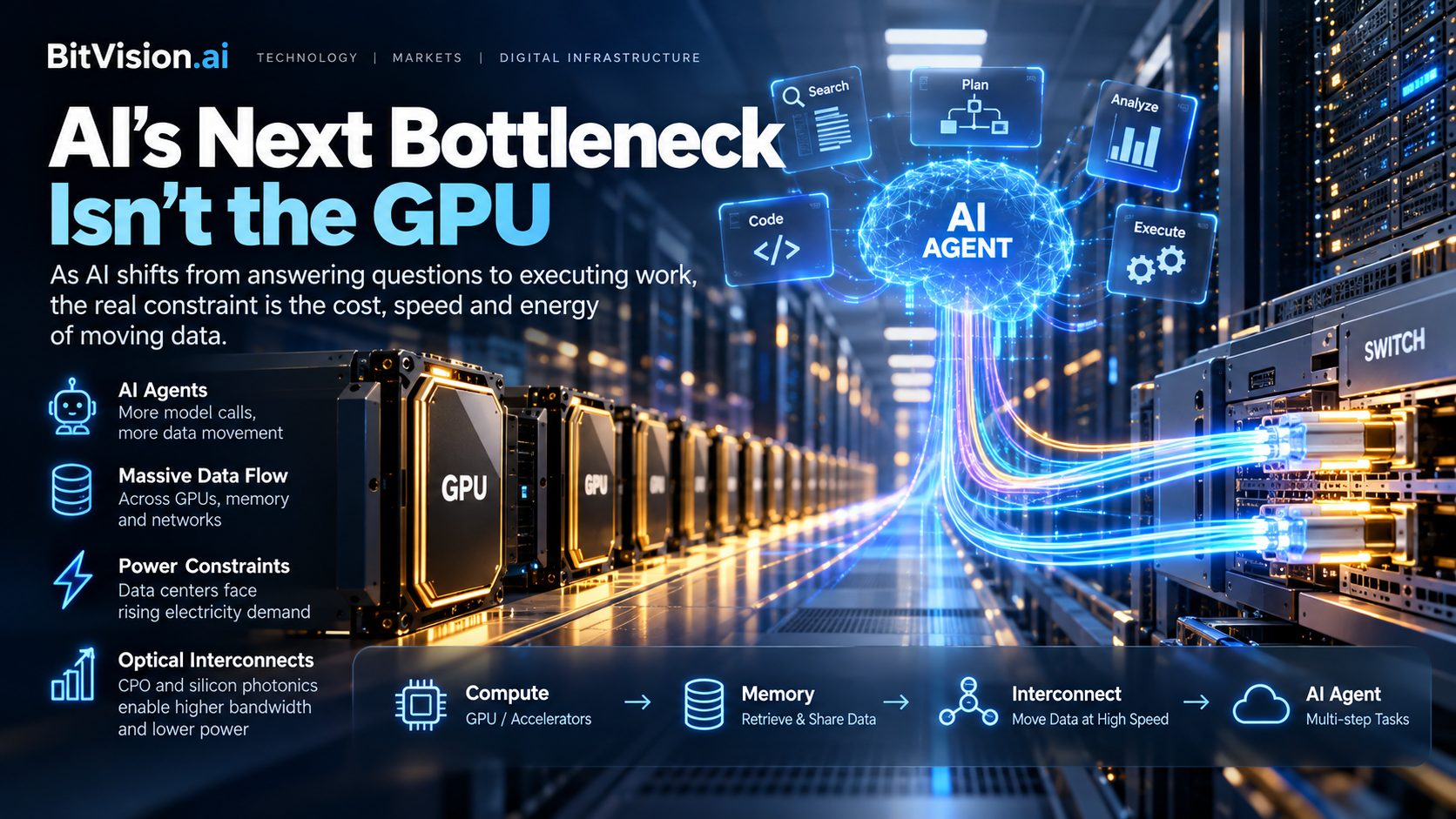
As AI shifts from answering questions to executing work, the binding constraint is moving from compute to the cost, speed, and energy of moving data.
BitVision.ai Research
The first phase of the AI boom was a race for GPUs. The next phase will be decided by what happens between them.
AI agents don’t answer once and stop. A single task can trigger document retrieval, multiple model calls, code execution, database queries, external API calls, and repeated self-evaluation. Every step moves data — between accelerators, across memory hierarchies, through the network fabric.
At scale, the question is no longer how many GPUs a data center can install. It is how efficiently those GPUs can exchange information without burning power or sitting idle waiting for data.
The new scorecard for AI infrastructure: useful computation per watt — and how efficiently bits move to make it happen.
Marvell’s Investor Day: Connectivity Moves to the Center
Marvell Technology’s October 2026 investor event made the shift explicit. The company tied its growth outlook to two pillars of AI infrastructure: custom silicon for specialized workloads, and the high-speed networking and optical interconnects that link compute together.
The signal matters more than any single revenue target. Connectivity is no longer a supporting function — it is becoming a core design variable.
The physics are simple. An accelerator cannot run at full utilization if its data arrives late. Adding thousands of processors doesn’t deliver proportional gains when congestion, communication overhead, and memory limits eat into useful work.
That is why capital is flowing into networking chips, optical DSPs, silicon photonics and advanced packaging. The value is migrating from the processor to the fabric that connects processors.
Agents Turn Inference Into a Networking Problem
Training grabbed the headlines because it demanded massive clusters running for weeks. Inference — running trained models in production — is now becoming the larger, more persistent source of infrastructure demand.
Agents compound it. A chatbot may answer with one model call. A research agent may execute dozens of operations before it returns a result.
Not every extra operation stresses the network equally. The impact depends on model architecture, workload placement, memory management, and whether work stays on one accelerator or spans a distributed system. The strongest drivers of interconnect demand are:
- Distributed inference — large models span multiple accelerators that must constantly exchange data.
- Model parallelism — splitting execution across processors creates latency-critical traffic.
- KV-cache and memory management — moving and sharing inference state becomes a first-order cost as context windows grow.
- Cluster scaling — bigger deployments need more bandwidth and smarter traffic engineering.
- Agent concurrency — thousands of simultaneous agents multiply aggregate east-west traffic.
Together, these push network architecture from the periphery to the center of AI system design.
Power Is the Hard Ceiling
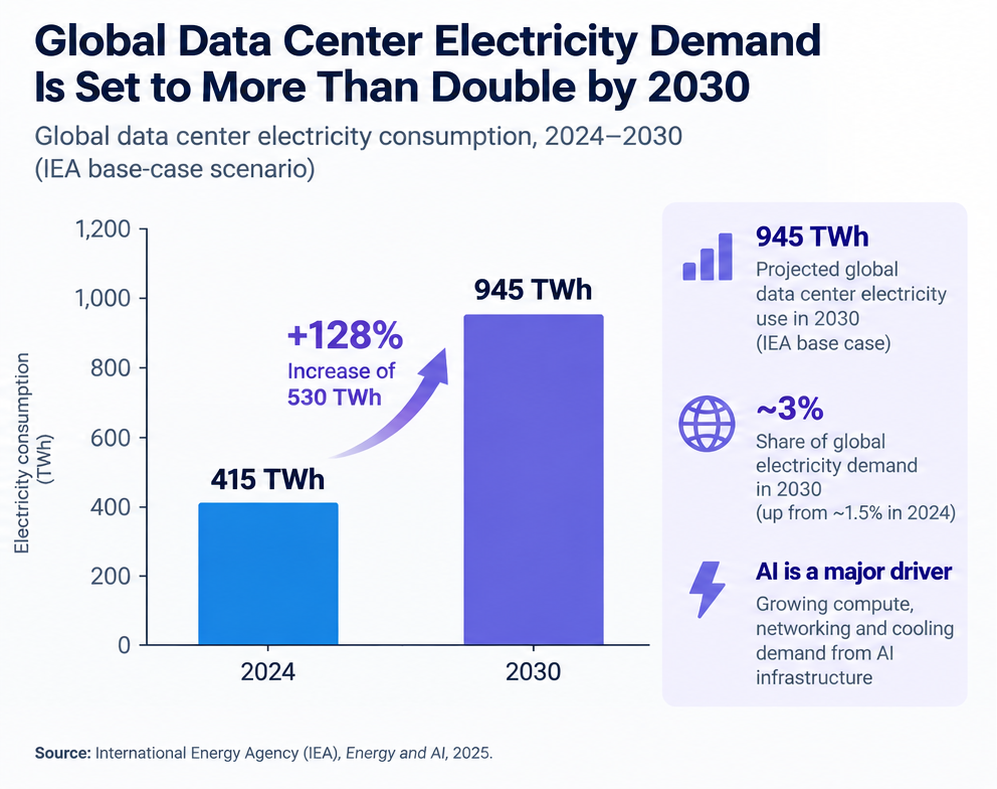
The International Energy Agency’s Energy and AI report (2025) puts global data center electricity use at about 415 TWh in 2024, rising to roughly 945 TWh by 2030 in its base case — an increase of about 530 TWh, or roughly 128%, in six years.
That figure covers all data centers, not AI alone. But AI is a primary driver of the growth.
The binding constraint is no longer just the GPU budget. It is generation capacity, transmission, transformers, cooling, and permitted sites. A grid interconnection queue can stall a cluster as surely as a chip shortage.
This rewrites the economics. When power is capped, performance per watt becomes the competitive edge. And when a growing share of each watt goes to moving bits rather than computing on them, network efficiency becomes strategy.
Why Light Beats Copper
Copper is excellent over short distances. But over longer electrical paths, signals push to extreme speeds, and attenuation, crosstalk, equalization overhead, and power draw all climb.
Optical links carry data as light. Fiber already dominates switch-to-switch, rack-to-rack and building-to-building links. The frontier now is bringing optics right up to the compute and switch silicon — the job of silicon photonics and co-packaged optics.
From Pluggables to Co-Packaged Optics
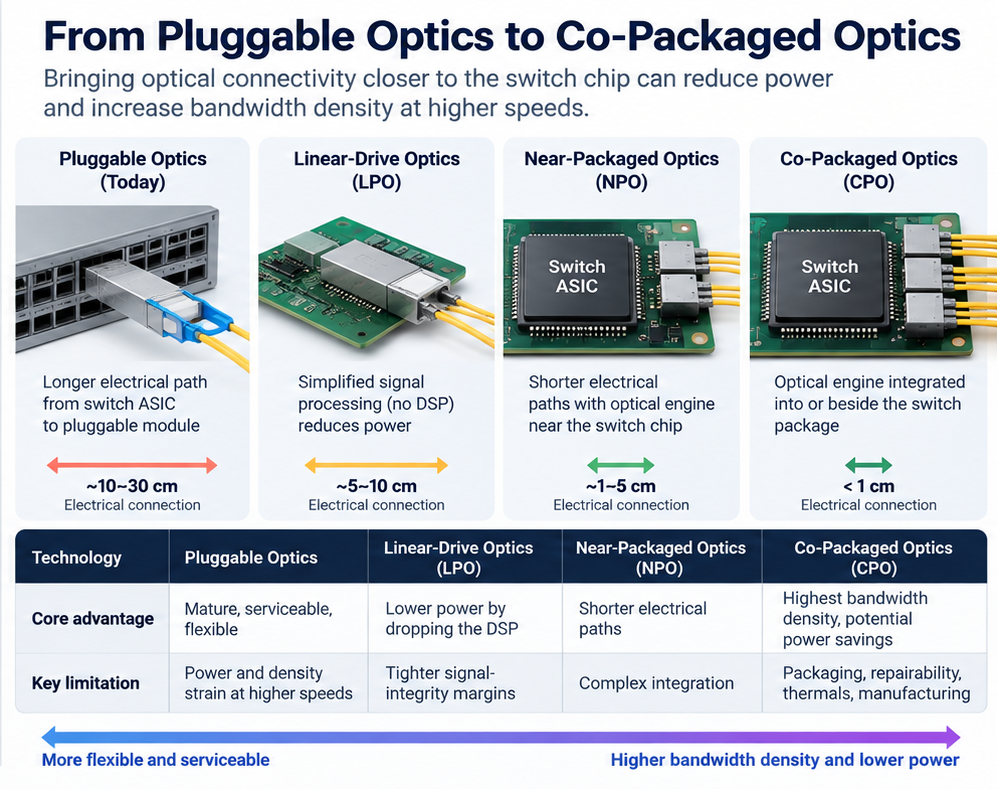
Today’s workhorse is the pluggable transceiver: a front-panel module that converts electrical signals to optical. It is mature, standardized, and hot-swappable.
But as port speeds climb from 400G to 800G, 1.6T and beyond, the electrical trace from switch ASIC to faceplate becomes the weak link. Co-packaged optics (CPO) moves the optical engine into or beside the switch package, shrinking that trace. The potential payoff: lower electrical loss, higher bandwidth density, and lower power in the right architectures.
CPO is not a drop-in replacement for every module. Its value depends on topology, yields, reliability, and serviceability.
| Pluggable optics | Mature, serviceable, flexible | Power and density strain at higher speeds |
| Linear-drive optics (LPO) | Lower power by dropping the DSP | Tighter signal-integrity margins |
| Near-packaged optics (NPO) | Shorter electrical paths | Complex integration |
| Co-packaged optics (CPO) | Highest bandwidth density, potential power savings | Packaging, repairability, thermals, manufacturing |
Expect coexistence, not a cliff. Pluggables will keep serving most links, while CPO gains ground first in high-radix switching where its gains justify the complexity.
NVIDIA Pulls Photonics Into the System
NVIDIA’s Spectrum-X Ethernet Photonics initiative shows optics moving deeper into AI system design. The company positions silicon photonics and CPO-based switching as a way to cut networking power and improve reliability at very high bandwidth densities, with switch architectures in the hundreds of terabits per second of aggregate capacity.
Read vendor efficiency claims in context. A cut in optical networking power does not translate one-for-one into total facility savings — GPUs, memory, cooling and storage still dominate the power budget. But as clusters scale, every watt saved in the fabric compounds.
The Market: Large, but Read the Fine Print
The opportunity spans transceivers, silicon photonics, lasers, optical engines, switch silicon, advanced packaging, and systems. Research firms including LightCounting and Yole Group project strong growth as 800G and 1.6T deployments ramp, and some forecasts see CPO becoming a multibillion-dollar market by decade’s end.
Compare forecasts carefully. A CPO optical-engine forecast is not a transceiver forecast, and neither is a full-photonics-supply-chain forecast. Projected demand is not realized revenue — timing, pricing, capacity, adoption, and competing architectures all intervene.
The real question is not how big the market gets. It is who can ship reliable parts at scale and keep their margins.
Mapping the Supply Chain
| Networking and custom silicon | Switching, signal processing, connectivity | Marvell, Broadcom, NVIDIA |
| Silicon photonics | Optical functions on semiconductor platforms | Intel, GlobalFoundries, TSMC ecosystem |
| Optical components and lasers | Light generation and transmission | Coherent, Lumentum |
| Optical transceivers | High-speed module assembly | Fabrinet and multiple module suppliers |
| Advanced packaging | Integrating optics with electronics | TSMC and specialized partners |
Exposure varies sharply across this map. A laser supplier can ride optical growth without capturing switch-silicon economics. Packaging players may carry heavy capex long before profits arrive. Technological relevance is not the same as revenue exposure.
Four Risks Investors Shouldn’t Ignore
- AI capex has to pay for itself. Hyperscaler spending needs economic returns. If monetization lags, buildouts slow.
- Optics is cyclical. Shortages lift prices and margins; aggressive capacity expansion can flip into oversupply and inventory corrections.
- CPO may arrive later than the hype. Yields, optical-engine reliability, external laser sources, field serviceability, and thermal integration are unsolved at volume.
- A great market isn’t a great stock. If valuations already price in aggressive growth, execution misses get punished. Watch free cash flow, customer concentration, capital intensity, and competitive position.
What to Watch Through 2030
Track measurable milestones, not narratives:
- Hyperscaler capex trends
- 800G and 1.6T deployment volumes
- Actual CPO production milestones
- Optical component lead times
- Network power efficiency
- Supplier gross margins
- Whether inference revenue and utilization justify continued buildout
The sharpest metric: incremental useful compute per dollar of incremental network investment. More theoretical bandwidth is not automatically more economic. The winners will improve real-world system performance at an acceptable total cost of ownership.
The Bottom Line
The first chapter of generative AI was defined by access to compute. The next will be defined by how efficiently that compute is connected, fed with data, and turned into useful work.
Agents, distributed inference, larger clusters, and hard power limits are making data movement central to AI economics. Optical interconnects — and eventually co-packaged optics — are one answer. Marvell’s ambitions, NVIDIA’s photonics push and investment across the optical supply chain all point the same way.
The transition won’t be linear, and not every optics name will win. The question for investors has changed:
Who captures the value of moving data as AI becomes larger, more distributed, and more autonomous?
The answer may define the next generation of AI infrastructure leaders.