
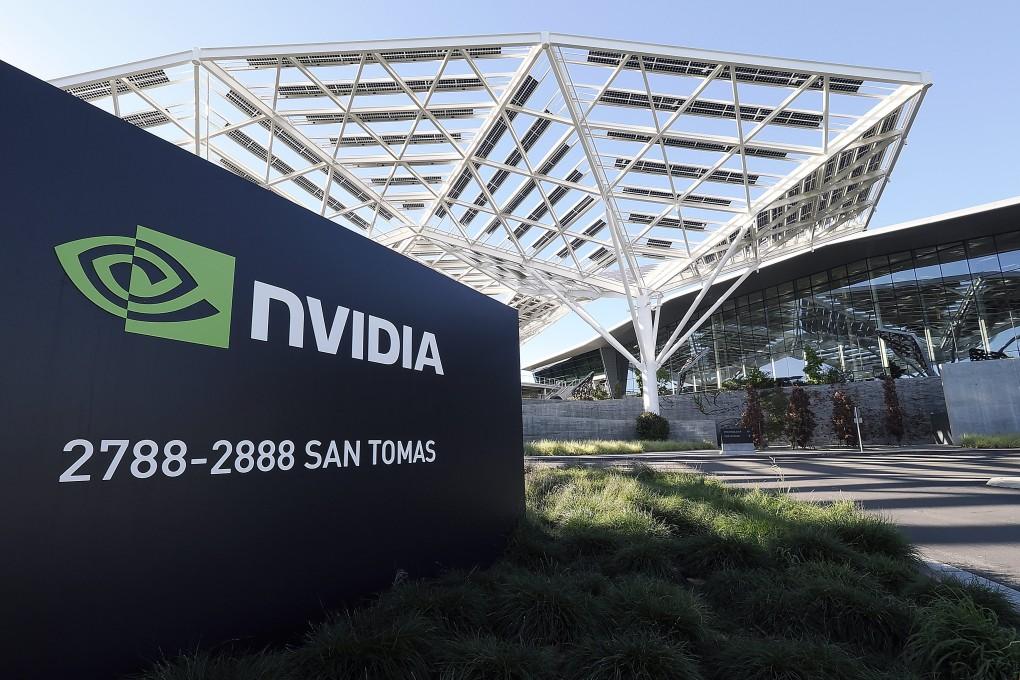
Nvidia is entering one of the most consequential leadership transitions in its history.
On November 12, 2026, the AI-chip giant announced that co-founder Jensen Huang had resigned as president, chief executive officer, and board member, effective immediately. The company appointed longtime Chief Financial Officer Colette Kress as interim CEO while it searches for a permanent successor.
Harvey C. Jones, a director since Nvidia’s founding in 1993, was named the company’s first board chair.
The announcement comes just days before Nvidia’s third-quarter fiscal 2027 earnings report on November 17 — a closely watched event that will now test more than financial performance.
For investors, customers, and competitors, the central question is no longer simply how fast Nvidia can grow. It is whether the world’s leading AI-chip company can maintain its momentum without the executive who helped build it.
A Leadership Transition at a Critical Moment
Huang’s departure ends more than three decades of leadership at a company that has become central to the global artificial intelligence industry.
Under his direction, Nvidia evolved from a graphics-chip manufacturer into a dominant supplier of accelerated computing infrastructure, powering AI research, cloud data centers, and increasingly sophisticated machine-learning systems.
His departure introduces uncertainty at a time when demand for AI computing remains strategically important to the technology industry.
Kress, who joined Nvidia in 2013, brings extensive financial and operational experience. She will continue serving as chief financial officer while assuming interim CEO responsibilities.
In its November 12 announcement, Nvidia emphasized continuity. The board expressed confidence in its leadership team and stated that operations, customer commitments, and the company’s technology roadmap were expected to continue without interruption.
Yet the transition raises important questions about long-term strategy, corporate governance, and the company’s ability to preserve customer confidence.
What Led to Huang’s Resignation?
Nvidia’s official transition announcement did not provide a reason for Huang’s departure.
However, reporting by Reuters, the Associated Press, and other news organizations has linked the resignation to disclosures concerning extramarital relationships, including allegations involving a woman suspected by U.S. authorities of having intelligence connections to China.
Reuters also reported that Nvidia’s board initiated an independent investigation into related security concerns.
These reports raise questions about corporate governance and national security, but the allegations must be distinguished from established legal findings.
Nvidia’s leadership announcement did not identify any violation of U.S. export-control laws, and the public reporting cited here does not establish that company secrets were compromised.
For Nvidia, the immediate business challenge is to demonstrate that its operations, partnerships, and strategic direction remain stable despite the controversy.
AMD, Google, and Broadcom See an Opening
Nvidia’s leadership transition comes as competition in AI computing intensifies.
Although Nvidia remains a major force in accelerated computing, competitors are expanding their offerings across GPUs, custom AI processors, and large-scale data-center infrastructure.
AMD Expands Its AI Accelerator Strategy
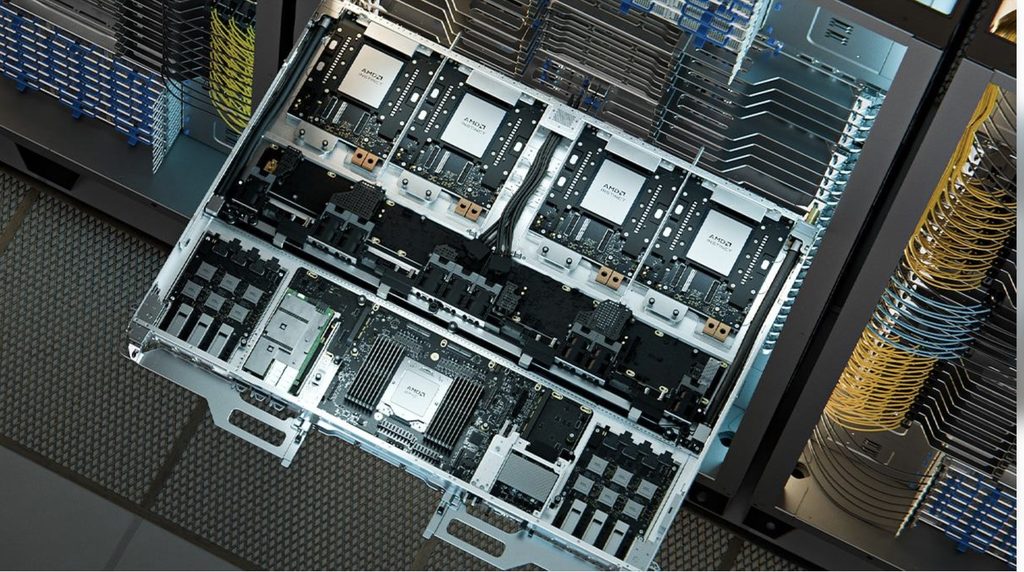
On November 12, AMD highlighted advances in its Instinct MI400 Series, including the MI450X accelerator and new inference-performance results for its MI455X processor running within the Helios rack-scale system.
AMD reported throughput of 21,333 tokens per second per GPU in a DeepSeek-R1 MLPerf Inference Offline configuration. The company claimed performance up to 30% higher than Nvidia’s latest published Vera Rubin result under the comparison it presented.
Those figures are AMD’s self-reported measurements and should not be taken as a universal performance advantage across all AI workloads.
Nevertheless, the announcement underscores AMD’s ambition to compete more aggressively in large-scale AI inference.
Google Expands Its TPU Ecosystem
Google is pursuing a different approach through its proprietary Tensor Processing Units.
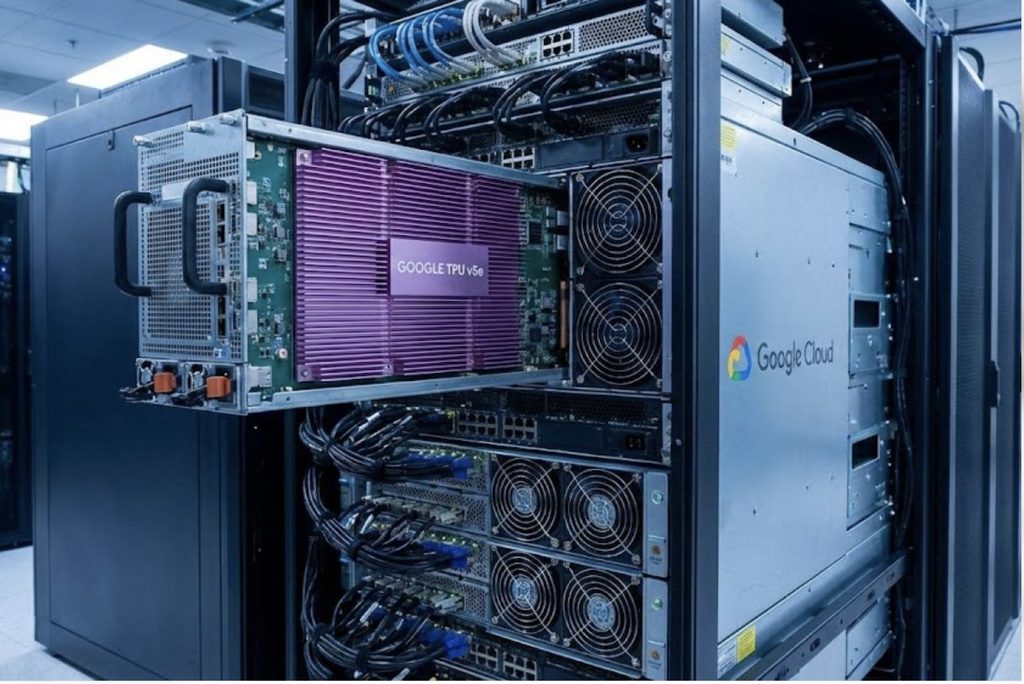
On November 9, Google announced additions to its eighth-generation TPU portfolio, including the TPU 8tx and TPU 8i Max.
The company said its TPU business serves nearly 100 customers and is expanding beyond Google’s internal AI operations into cloud services and customer-operated data centers.
Google’s strategy reflects a broader industry trend: major technology companies increasingly want specialized processors optimized for their own AI workloads.
Broadcom and the Custom-Chip Opportunity
Broadcom is another important participant in the changing AI infrastructure market.
As hyperscale cloud providers explore custom silicon, Broadcom’s position in specialized semiconductor design gives it exposure to a market that could grow alongside, rather than simply replace, demand for Nvidia GPUs.
The competitive landscape is becoming more diverse, with Nvidia, AMD, Google, and Broadcom pursuing different approaches to AI computing.
The key question is whether Nvidia’s leadership transition will affect customers’ purchasing decisions or accelerate diversification toward alternative suppliers.
Wall Street Reassesses the AI Chip Market
Investors reacted quickly to Nvidia’s leadership change.
CNBC reported on November 13 that AMD and Broadcom had each gained approximately 17% over the preceding week, as traders evaluated the possibility of increased competition in the AI-chip market.
Nvidia vs. AMD vs. Broadcom: Stock Performance (Nov. 6–13, 2026)
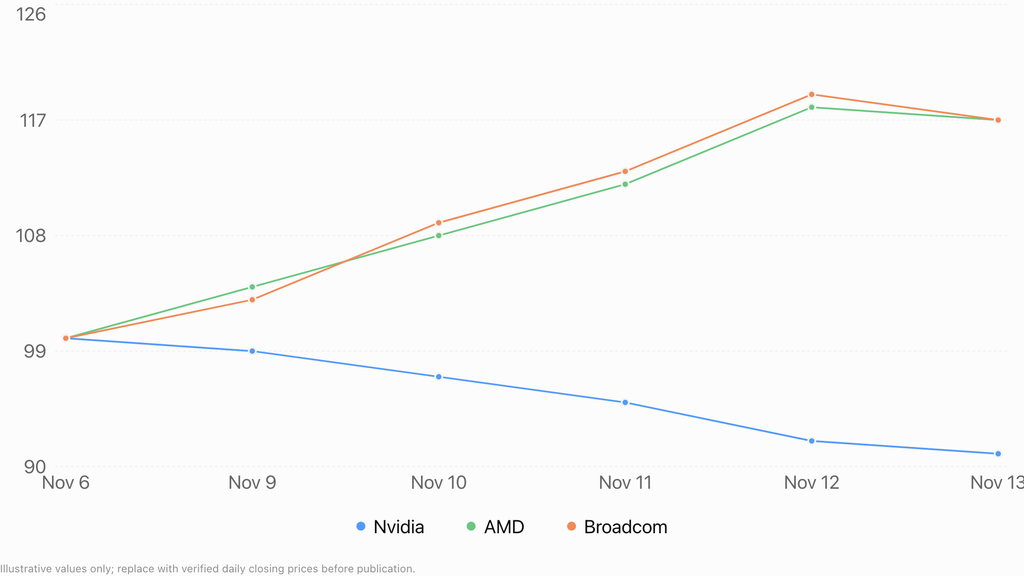
Market strategists suggested that Nvidia’s challenge now extends beyond technology leadership to maintaining customer trust.
However, stock-price movements do not establish that customers have transferred orders or that competitors have captured additional market share.
Nvidia’s competitive position still depends on its software ecosystem, hardware performance, manufacturing partnerships, product execution, and relationships with major cloud providers.
The leadership transition adds another variable to an already complex investment outlook.
U.S.–China Chip Restrictions Add Pressure
Nvidia’s challenges extend beyond corporate leadership and commercial competition.
Advanced semiconductor exports remain a major point of tension between Washington and Beijing, particularly as governments increasingly view AI computing capacity as strategically important.
Reuters reported on November 12 that U.S. lawmakers were considering additional restrictions designed to limit China’s access to advanced AI chips and computing infrastructure.
Proposals under discussion include measures addressing chip security, export oversight, and remote access to AI computing systems.
These proposals should not be confused with laws already enacted.
On November 13, Reuters reported that its review of Chinese procurement and investment records identified projects and equipment agreements totaling more than $3.2 billion associated with restricted Nvidia processors.
Importantly, that estimate included infrastructure spending, planned investments, and other project costs — not merely purchases of Nvidia chips.
The findings highlight the complexity of enforcing semiconductor export restrictions across global supply chains.
Treasury Secretary Scott Bessent also raised concerns in a CNBC interview about potential weaknesses in chip-distribution oversight and the need for stronger safeguards.
His remarks reflect policy concerns and allegations, not a completed legal finding against Nvidia.
For the company, export controls remain a significant strategic issue regardless of who occupies the CEO position.
November 17 Earnings: Nvidia’s First Major Test
Nvidia is scheduled to report its third-quarter fiscal 2027 financial results on Tuesday, November 17, at approximately 1:20 p.m. Pacific Time, followed by an earnings conference call at 2 p.m.
The results will offer investors their first major opportunity to hear from Kress as interim chief executive.
While the earnings report cannot resolve every question surrounding the leadership transition, it may provide important insight into the company’s immediate direction.
Several issues deserve particular attention:
1. AI Infrastructure Demand
Will Nvidia’s reported results and management commentary indicate continued demand from major cloud providers and AI developers?
2. Customer Confidence
Can management reassure customers and investors that existing commitments, product schedules, and strategic partnerships remain on track?
3. Competitive Position
How will Nvidia address the growing alternatives offered by AMD, Google, and custom-chip developers?
4. China and Export Restrictions
Will management provide additional clarity on the financial impact of export controls and the company’s compliance strategy?
5. Leadership and Governance
Will Kress outline priorities for the transition, and will the board offer further information about its search for a permanent CEO?
These questions will help determine how investors interpret Nvidia’s near-term outlook.
Beyond Jensen Huang: The Future of AI Computing
Nvidia’s transition also raises a broader question about the technology industry: how dependent should a major company be on the vision and leadership of one individual?
Huang played a defining role in Nvidia’s development, but the company’s position in AI computing also rests on decades of engineering investment, software development, manufacturing relationships, and customer partnerships.
Those assets do not disappear with a leadership change.
At the same time, strong technology alone does not eliminate execution risks. Competitors are investing heavily, customers are exploring alternatives, and governments are reshaping the rules governing advanced semiconductor trade.
The coming months will reveal how effectively Nvidia’s management team can navigate these pressures.
For the wider AI industry, the transition may become an important test of whether established technology leaders can maintain their advantages as competition broadens and AI infrastructure evolves.
Conclusion: Nvidia Enters a New Chapter
Jensen Huang’s resignation marks a historic turning point for Nvidia and the AI industry.
With Colette Kress serving as interim CEO, the company faces the immediate task of preserving operational stability while responding to investor concerns, competitive pressure, and geopolitical uncertainty.
AMD, Google, and Broadcom are advancing their own AI-computing strategies, but it remains too early to conclude that Nvidia’s leadership change has fundamentally altered the competitive balance.
The November 17 earnings announcement will provide the next major set of financial and management disclosures.
For Nvidia, the challenge is clear: demonstrate that its technological leadership, customer relationships, and long-term strategy can endure beyond its founding CEO.
For the rest of the industry, the next chapter of AI computing is only beginning.